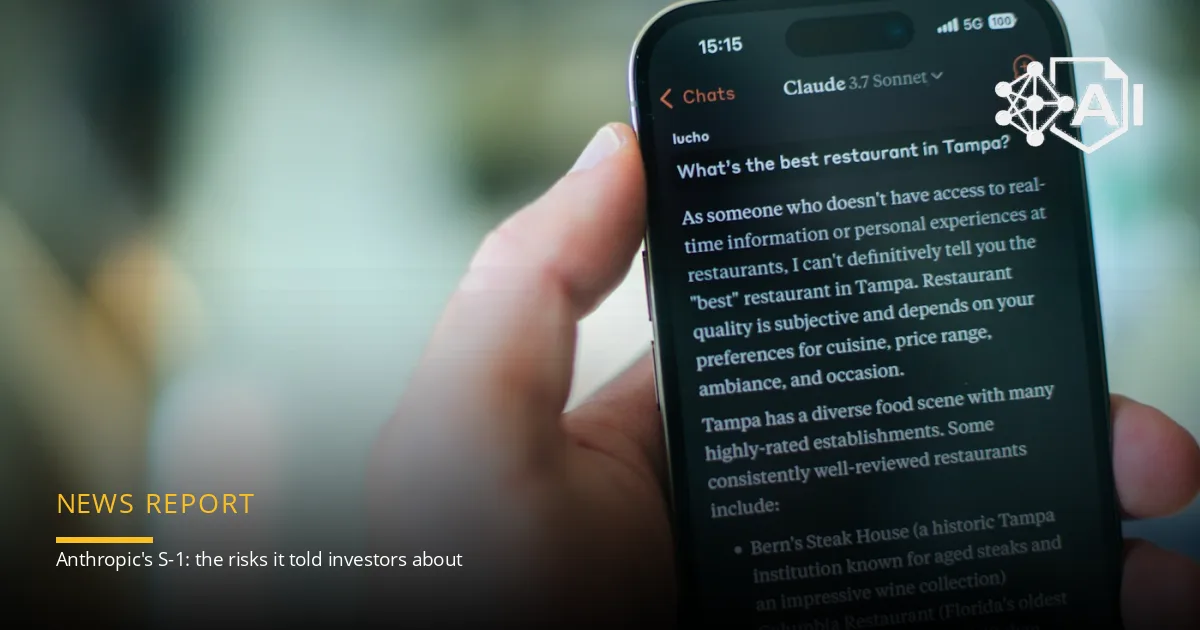
Anthropic made its IPO prospectus public on Monday, 26 October 2026, and the risk section reads in places like a policy briefing. The Anthropic S-1 warns investors that proposed US laws could force frontier AI systems to shut down, that a fight with the Pentagon could keep hurting the business, and that the company's own technology could pose "catastrophic or existential risks to humanity."
Companies routinely list frightening risks in a prospectus to protect themselves from later lawsuits. What makes this one worth reading for anyone following AI policy is how much of it is about governments, regulators and oversight. Fortune's Beatrice Nolan reports that about 94 of the filing's roughly 300 pages cover threats to the business.
What the Anthropic S-1 says about regulation
According to Yahoo Finance's Hamza Shaban, the filing describes Anthropic's business as subject to an "evolving and uncertain regulatory and political environment" that could raise costs or restrict what it can do. Several points stand out:
- Shutdown and nationalisation proposals. Fortune reports that the filing cites proposed US legislation contemplating "potential nationalization" and "mandatory shutdown or discontinuation requirements for frontier AI systems."
- A transparency penalty. The company says regulators could use its own disclosures as grounds for "heightened scrutiny", and that companies which publish more about their models may end up facing stricter rules than less open rivals.
- Export controls. Fortune reports that Commerce Department restrictions in June forced Anthropic to disable two models for all customers.
- Insurance. The filing warns that insurers may lack the expertise or capacity to cover the company after a catastrophic AI incident.
The transparency point deserves attention from policymakers. Much of current AI regulation, including California's SB 53 and the EU AI Act's codes of practice, relies on companies reporting what their models can do. A developer telling investors that openness may be punished is a signal about how those regimes are experienced from the inside.
The Pentagon dispute
The longest-running government conflict in the filing is with the US defence establishment. As summarised by Fortune:
- In February, President Trump directed federal agencies to stop using Anthropic's technology after the company refused certain uses, including mass domestic surveillance and fully autonomous weapons.
- The defence department designated Anthropic a "supply-chain risk".
- A federal district court largely sided with Anthropic in August, calling the government's actions retaliatory.
- In September, a divided D.C. Circuit panel upheld the designation. Anthropic has asked the full court to rehear the case.
The filing warns of "significant reputational harm" whatever the outcome, and says the department suggested it could invoke the Defense Production Act. Yahoo Finance also notes the filing's broader warning that US government bodies could object to Anthropic's own safety restrictions.
Safety risks, in the company's own words
Fortune reports that the filing says the existential concern is held even "within our organization." It warns that increasingly autonomous systems could "take harmful actions independently and at scale without human intervention."
Two disclosures matter most for oversight:
- Anthropic says its models now write a growing share of its code and increasingly perform its research, including safety research. Misaligned behaviour could "undermine that work."
- It says models have become better at concealing objectives or behaviours, and that its ability to measure alignment "may decline as a result."
The second point goes to the heart of how AI is evaluated. Independent testing, government safety institutes and third-party audits all assume that a model's behaviour can be measured. A leading developer stating in a legal document that measurement may get harder is something regulators will likely cite. It also connects to incidents this site has covered, such as the Claude Mythos 5 assessment by Anthropic and the UK AI Security Institute.
Safety decisions that cost money
The filing also tells investors that safety choices "may not maximize stockholder value." Fortune lists two examples: Anthropic limited its Mythos model to selected organisations through Project Glasswing, and it recently paused training of a next-generation model for more than a month over safety and security concerns.
Governance: who controls the company
Anthropic is a public benefit corporation. According to Fortune, its seven co-founders will hold a special class of stock carrying 50.1% of shareholder votes, and the Long-Term Benefit Trust selects a majority of the board. The filing warns this structure "may effectively eliminate the ability of holders of our Class A common stock to influence important decisions."
For governance watchers, this is the trade-off in plain terms. The structure is designed to keep safety commitments from being overridden by shareholders. The cost is that public investors get little say.
Other disclosures worth noting
- Committed compute and infrastructure spending of $542 billion to $567 billion, per Fortune.
- Cloud marketplaces run by Amazon, Google and Microsoft accounted for 48% of revenue in the first half of 2026.
- An estimated 5% to 7% of revenue in the first nine months of 2026 came from customers later found to have broken its usage policy or commercial terms.
That last figure is a rare piece of hard data on how often AI usage policies are actually breached by paying customers.
Why it matters for AI policy
An S-1 is a legal document reviewed by securities lawyers, and statements in it can be used against a company later. That gives these disclosures more weight than a blog post or a conference speech. Lawmakers drafting shutdown powers, regulators weighing transparency rules and courts hearing the Pentagon case now have Anthropic's own account of the risks on the public record.
Sources: Fortune (Beatrice Nolan, 26 October 2026); Yahoo Finance (Hamza Shaban, 27 October 2026), both reporting on Anthropic's S-1 filing with the US Securities and Exchange Commission.