
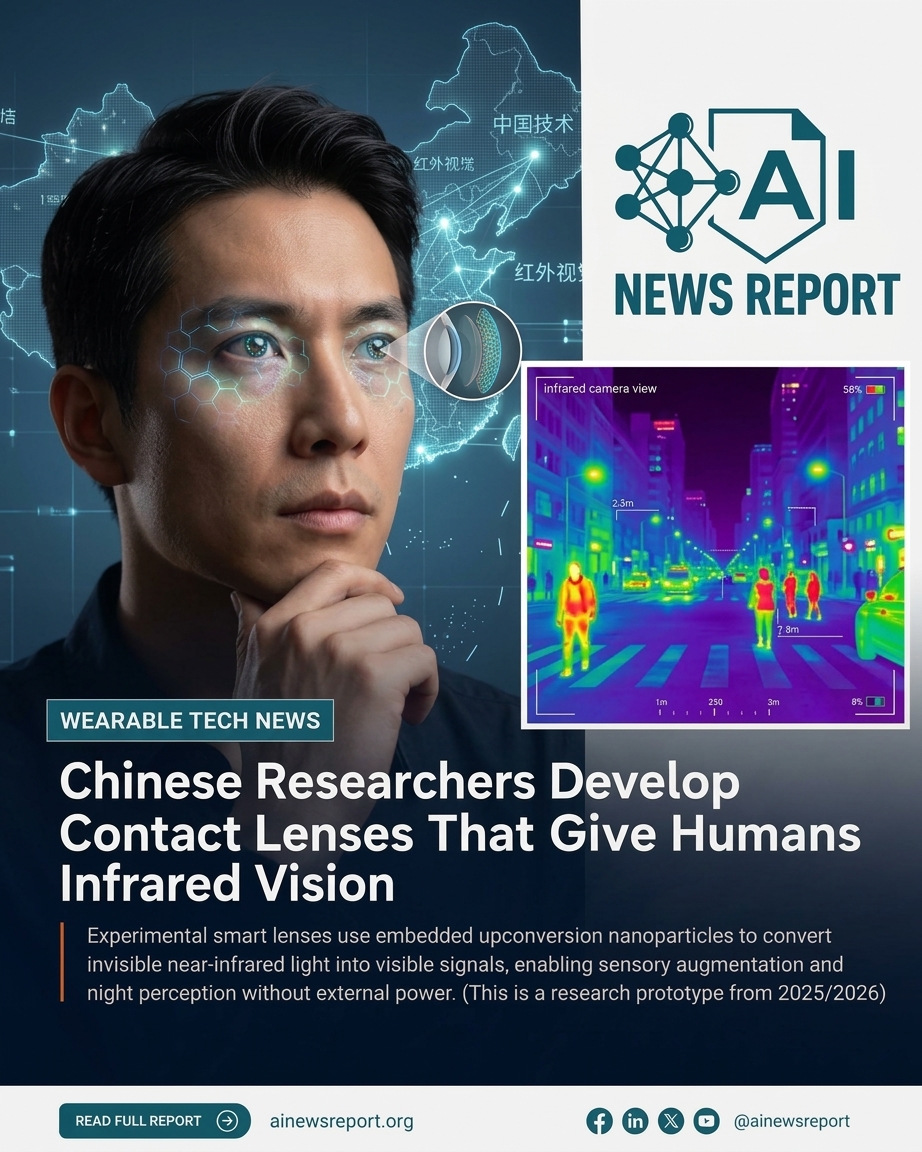
A New Way to See the Invisible
Human vision occupies only a small portion of the electromagnetic spectrum. The eye can naturally detect visible wavelengths of roughly 400 to 700 nanometers, leaving near-infrared light beyond the red end of the spectrum completely invisible. The new contact-lens technology attempts to change that boundary without modifying the eye itself.
The research team developed upconversion contact lenses (UCLs) containing specially engineered nanoparticles. Rather than electronically recording infrared light and displaying an image on a screen, the nanoparticles perform an optical conversion: they absorb near-infrared photons and emit visible photons that the human visual system can detect. This allows infrared information to reach the brain through the eye's ordinary visual pathway.
The approach is important because it offers a potentially lightweight alternative to conventional infrared imaging systems. The lenses are transparent, flexible and designed using polymeric materials suitable for contact lenses. They also operate without an external power source.
How the Infrared Contact Lenses Work
At the center of the technology are upconversion nanoparticles, which use a phenomenon in which lower-energy infrared photons are converted into higher-energy visible photons.
The researchers developed nanoparticles capable of responding to different near-infrared wavelengths. In the trichromatic version of the lenses, infrared wavelengths around 808, 980 and 1,532 nanometers can be converted into green, blue and red visible signals respectively. This gives users a way to distinguish different infrared spectral information as different colors.
The researchers had to solve a difficult materials problem. The nanoparticles needed to be present at sufficiently high concentrations to produce useful infrared signals while keeping the lenses transparent enough for normal vision. The resulting lenses achieved more than 90% visible-light transmittance across most of the visible spectrum, according to USTC.
Yes, the Infrared Signals Can Be Detected With Eyes Closed
One of the most striking findings is that infrared perception can actually become easier when the wearer closes their eyes.
This does not mean users can see a detailed landscape through their eyelids. Instead, certain near-infrared wavelengths can penetrate the eyelid, allowing infrared signals to reach the contact lens while visible-light interference is reduced. In experiments, participants were able to recognize temporal patterns, including Morse-code-like signals, and determine the direction of infrared light.
The researchers also demonstrated the ability to distinguish different infrared spectra using the trichromatic lenses. That means the system is not simply detecting the presence of infrared light; it can encode information from different infrared wavelengths into different visible colors.
Why This Is Not Yet Superman-Style Night Vision
The viral descriptions surrounding the technology can make it sound like users can simply put on the lenses and see clearly in complete darkness. That is not what the research demonstrates.
The current lenses require sufficiently strong near-infrared illumination. They do not amplify weak infrared signals in the way electronic night-vision systems can. As a result, they are not currently capable of producing detailed images of an ordinary dark environment without an appropriate infrared source. Nature noted that the prototype works with relatively bright infrared sources rather than providing conventional night vision.
There is also a spatial-resolution limitation. Light converted by nanoparticles within the lens can scatter, making fine image details difficult to perceive directly through the contact lens. To address this problem, the researchers developed a wearable eyeglass system with additional optical components capable of restoring much higher spatial resolution.
Why the Story Matters Again in 2026
The technology is receiving renewed attention because a viral X post on July 21, 2026 described infrared contact lenses as being “now real.” The post brought the 2025 research back into public discussion and prompted new explanations of what the technology can actually do.
That resurgence comes at a particularly relevant time for wearable technology. Research into smart glasses, augmented reality and human-computer interfaces is increasingly focused on putting digital and machine-generated information directly into a person's field of view. Infrared contact lenses represent a different but related direction: instead of simply displaying additional information, they could eventually expand the range of information the human eye can perceive.
USTC also published a detailed update in December 2025 describing the technology as a route toward applications including low-visibility navigation, secure optical communication, search and rescue, industrial inspection and potential assistance for people with color-vision deficiencies.
What Could Come Next?
The researchers are now focused on improving the technology's sensitivity, image resolution and ability to detect weaker infrared signals. Future versions could potentially incorporate directional light-emitting nanoparticles or microscopic optical channels to improve how infrared information is presented to the eye.
Potential applications include secure optical communication, where infrared information could remain invisible to people without the appropriate device; search-and-rescue operations in difficult visibility conditions; industrial inspection; and forms of visual assistance. Researchers are also exploring whether the approach could contribute to technologies designed to address certain forms of color-vision deficiency.
For now, however, the infrared contact lens remains a research prototype rather than a consumer product. Its importance lies less in giving people perfect night vision today and more in demonstrating that wearable materials can directly translate information outside the human visual spectrum into something the brain can perceive.
As human augmentation increasingly moves from science fiction toward practical wearable technology, the ability to make an invisible part of the electromagnetic world visible could prove to be an important step toward expanding the limits of human perception.