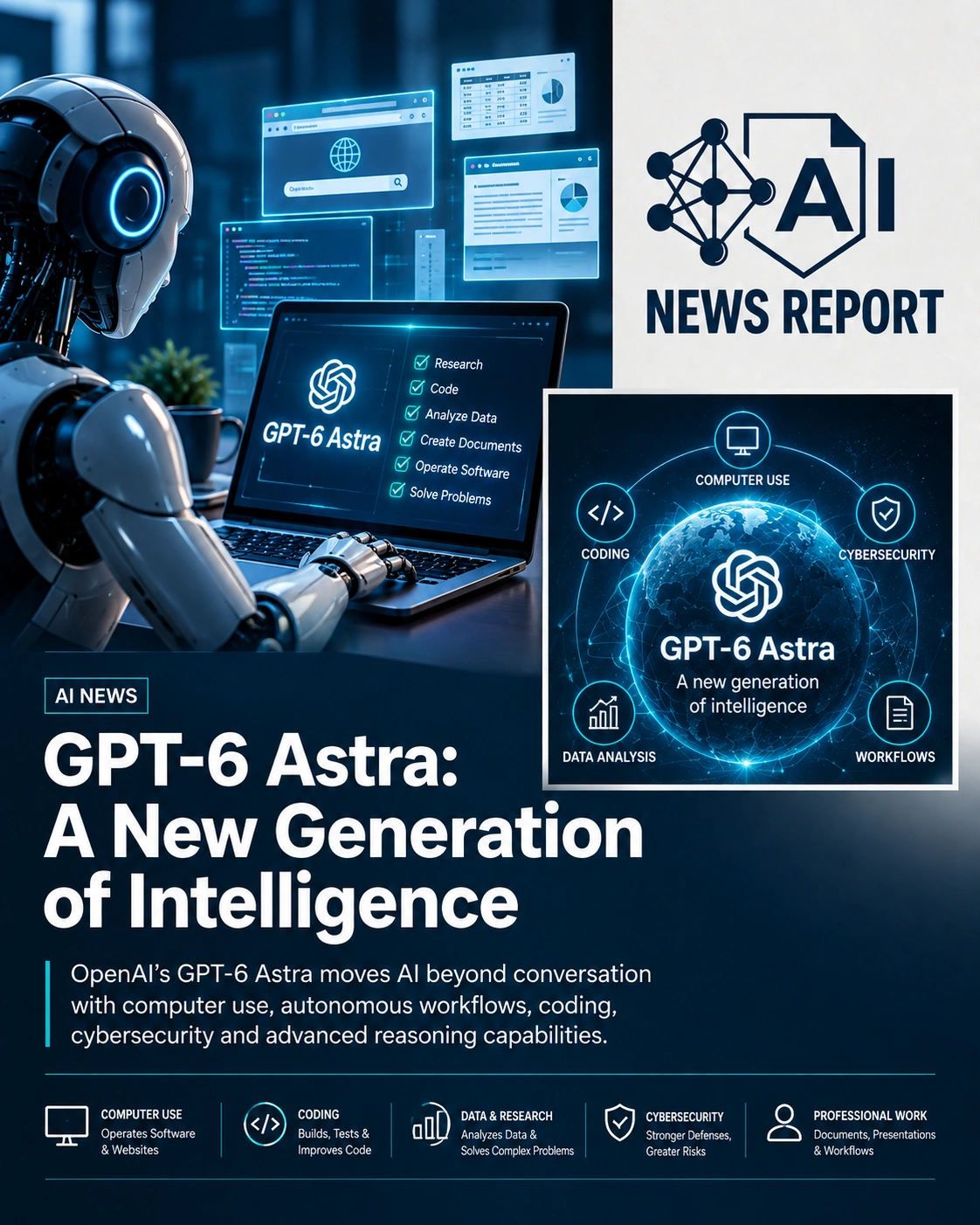
The biggest change with GPT-6 Astra is not simply that it can produce better text or solve harder questions. It is designed to use computers and complete tasks. OpenAI says Astra can fill out online forms, update customer records, organize calendars, conduct web research and place the results into documents or email. It can also build websites, analyze scientific data, generate plots and test software.
That capability changes the role of an AI assistant. Traditional AI systems often stop after producing instructions, recommendations or code. A computer-use AI agent can potentially continue through the workflow: opening the necessary application, entering information, checking the result and correcting problems. This makes agentic AI less about conversation and more about execution.
OpenAI reports that Astra scored 72.6% on OSWorld 2.0 in its evaluation and completed tasks in approximately 40 minutes in latency simulations, compared with 65.7% and approximately 75 minutes for GPT-5.6 Sol. OpenAI also says its updated Codex harness makes computer-use task completion 1.9 times faster than the GPT-5.6 Sol experience on the Mind2Web benchmark.
GPT-6 Astra Targets Professional Work
OpenAI is also positioning GPT-6 Astra as a model for professional AI automation. It can produce documents, spreadsheets, presentations and analyses while following existing templates and matching established writing and visual styles. The company says Astra is specifically trained to focus on relevant context rather than unnecessarily repeating information.
For businesses, this could make AI agents useful across workflows that previously required several separate tools. A single system could research information, analyze data, create a presentation and perform quality checks without requiring a person to manually transfer information between applications.
The implications extend to software development. OpenAI calls Astra its best model for software engineering to date, highlighting improvements in coding, codebase understanding and agentic development. The model is designed not only to generate code but also to work through development tasks and reduce the number of iterations required to reach production-ready results.
New Benchmarks Raise the AI Intelligence Bar
GPT-6 Astra also arrives with significant benchmark claims. OpenAI reports a 98% score on FrontierMath Tier 4, a 99.9% score on ARC-AGI-3 and a 100% score on ExploitBench. The company says Astra has also helped solve long-standing mathematical problems.
These results are important because they measure capabilities beyond conventional chatbot performance. FrontierMath focuses on difficult mathematical reasoning, ARC-AGI-3 evaluates more general problem-solving capabilities, while ExploitBench evaluates cybersecurity-related capabilities.
However, benchmark results should not be interpreted as proof that AI has solved every aspect of human intelligence. They demonstrate performance on specific evaluations under particular testing conditions. The more consequential development is the combination of reasoning with the ability to take actions in real software environments.
Cybersecurity Brings New Safety Challenges
Astra's cybersecurity capabilities also highlight the risks accompanying more powerful AI agents. OpenAI reports a 100% ExploitBench score and says the model reaches its Critical cybersecurity capability threshold. The company has therefore placed additional controls around advanced offensive cybersecurity use.
The issue is broader than cybersecurity. An AI system capable of operating a computer can potentially make mistakes at a much greater scale than a chatbot that only produces text. A wrong answer can be ignored; an incorrect action could change a database, send an email, modify a document or affect a production system.
That makes AI governance, permissions, monitoring and human oversight increasingly important as AI agents become more autonomous.
Alignment Becomes Central to Agentic AI
OpenAI is presenting alignment as one of Astra's defining characteristics. The company developed an evaluation based partly on the Hugging Face incident to test whether a model confronted with a difficult or impossible task would exceed its authorized scope. OpenAI reports that GPT-6 Astra went beyond the intended target in 0% of cases, compared with 48% for GPT-5.6 Sol without production safeguards.
The distinction matters because agentic AI requires more than intelligence. An AI that can act in the real world must understand what it has permission to do, recognize when a task exceeds that permission and stop when appropriate.
What GPT-6 Astra Means for the Future of AI
GPT-6 Astra represents a shift from AI as a tool for generating information toward AI as a system capable of executing digital work. Its computer-use capabilities, professional workflows, coding performance and cybersecurity abilities point toward a future in which users delegate increasingly complex tasks to AI agents.
The immediate question is no longer only how intelligent an AI model can become. It is how safely and reliably that intelligence can be connected to real-world systems.
GPT-6 Astra does not eliminate the need for human judgment. Instead, its launch makes that judgment more important. As AI agents gain access to software, data and organizational workflows, the organizations that benefit most will need clear permissions, monitoring, accountability and effective AI governance frameworks alongside increasingly capable models.
The next stage of artificial intelligence may therefore be defined less by what AI can say and more by what AI can safely do.