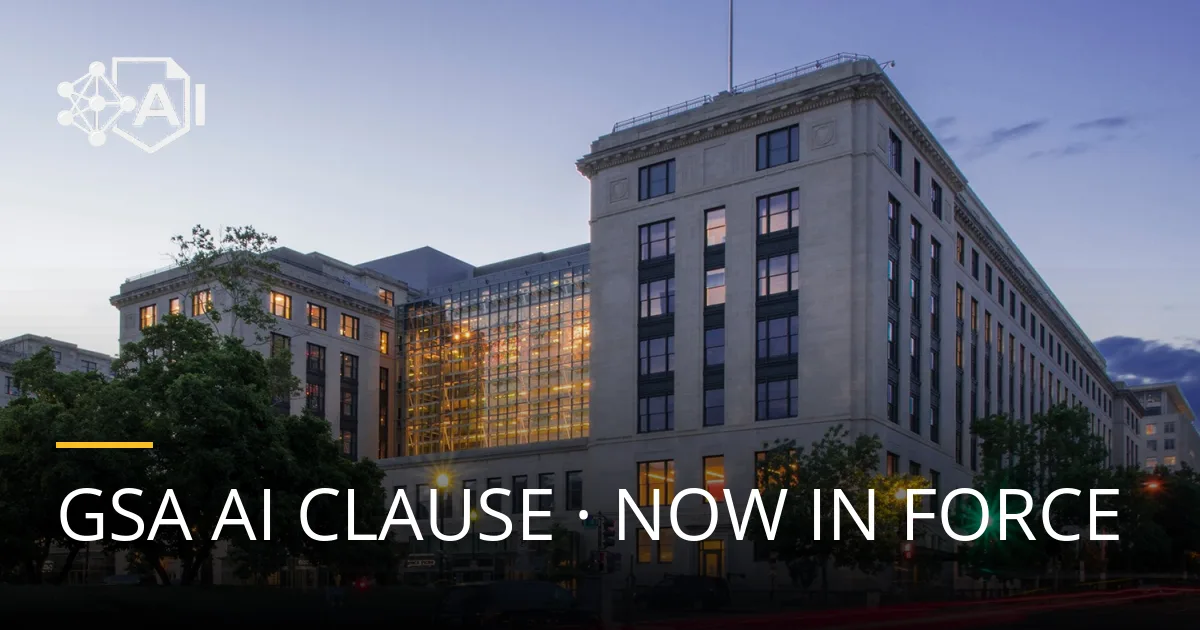
The US government's main buying agency now has its own rulebook for artificial intelligence. The GSA AI clause, formally GSAR 552.239-7001, "Basic Safeguarding of Data within Large Language Model Artificial Intelligence Systems", took effect on 19 October 2026 as a class deviation. From that date, contracting officers at the General Services Administration can write it into contracts for products and services built on large language models.
It is the third version of the clause this year. The first draft drew heavy pushback from industry and was withdrawn. A revised draft followed, then a listening session, and the version now in force is narrower than either of them. Federal contractors that sell anything with an LLM inside it will want to read it closely.
What the GSA AI clause covers
The clause applies when the government buys a system where government data goes into, or comes out of, an LLM-based tool. According to a summary by Stephanie Hagan of the contracting consultancy Winvale, it does not apply to a contractor's internal back-office systems that the government never touches, or to AI features that are incidental to a product whose main purpose is something else, unless the contracting officer says otherwise.
Kevin Martin, a GSA program manager, described that carve-out plainly, as reported by SAMSearch: the clause "self-deletes when LLM use stays inside the contractor's own back-office systems."
Emily Murphy, a former GSA administrator now at George Mason University's Baroni Center for Government Contracting, told Federal News Network that the trigger is whether the LLM is a "material" feature of what is being sold. That test may sweep in some productivity tools that earlier drafts left out. She also said the line around administrative functions is still ambiguous, and that different contracting officers may read "material" differently.
Rules on government data
The core of the clause is about data. Covered contractors may not use government data to train or fine-tune models for other customers, for advertising, or for sale to third parties. The final text also narrows what counts as a data output: metadata and logs are no longer included, a change contractors had asked for.
On intellectual property, the government does not take ownership of a contractor's pre-existing commercial products, including its models, configurations and know-how. Improvements that do not draw on government data stay with the contractor. Murphy said the final version gives contractors better IP protection than the drafts did.
One point is drawing concern. The clause takes precedence over conflicting commercial agreements, which Murphy warned could override the end-user licence agreements that commercial software normally ships with.
Incidents, testing and the right to switch a model off
The clause gives the government a set of controls over deployed systems:
- Incident reporting. Contractors must report covered incidents within 72 hours of actually knowing about them. Reports already filed under FedRAMP or with CISA can satisfy the rule if they carry substantially the same information and reach the contracting officer at the same time.
- Testing. The government can evaluate deployed systems, including automated assessments for bias, truthfulness and safety.
- Suspension. The government can suspend use of a covered LLM.
- Model changes. Contractors must give notice when a model change affects trustworthiness, security or operational integrity.
The clause leans on the NIST AI Risk Management Framework. Its flow-down to subcontractors reaches only those who design, develop, deploy or operate and monitor the model, the lifecycle stages that framework describes. Prime contractors must make "best efforts" to pass the terms down.
Liability is capped at 25%
If a contract is terminated for default and the AI system has to be removed, the contractor's liability for decommissioning costs is capped at 25% of the affected task or delivery order, according to Winvale's summary. Re-procurement costs and the cost of building a replacement system fall outside that cap.
Where the bias language went
Earlier drafts carried a set of "Unbiased AI Principles" that industry said would be hard to prove in practice. Most of that language is gone. Contractors must now make reasonable efforts to configure their models for accuracy and objectivity, and the government keeps the right to test for bias. Murphy said the neutrality requirements in the first draft were among the hardest parts to meet.
Open models get their own treatment
The final clause separates fully open models from open-weight ones. A fully open model must have publicly inspectable architecture, weights, code and training, validation and testing data under suitable licences. Those components are exempt from flow-down provisions on origin, ownership, jurisdiction and foreign control. An open-weight model released without its code and data does not qualify and still needs a documented best-effort review.
Murphy flagged that distinction as one of the open questions, along with how the clause will interact with the Department of War's own commercial licensing terms.
When contractors will actually see it
Contracting officers can use the clause now, and may apply it to existing contracts at their discretion. For most vendors on the Multiple Award Schedule, the bigger moment is Refresh #34. GSA has listed the clause for that refresh, which Winvale expects in November 2026. Murphy told Federal News Network she did not expect a mass modification for another 30 to 45 days, followed by roughly three months before it shows up in contracts.
The deviation is not the last word. It will later go through formal rulemaking, which brings another public comment period. Murphy expects inconsistent use in the meantime and warned that agencies could end up with different AI clauses, with the Department of War, GSA and the Department of Homeland Security each writing their own.
Why it matters beyond Washington
Government procurement rules often shape private practice, because vendors build one product and sell it to everyone. A 72-hour incident window, a ban on training with customer data and a government right to switch a model off are the kinds of terms large enterprise buyers may start asking for too.
The clause also shows the federal approach to AI taking shape through purchasing power rather than legislation. That pattern is visible in other recent moves, including the DHS order telling federal agencies to remove DeepSeek and tools built on it. For companies selling AI to the US government, the practical rules are now being written into contracts first.
Sources: Federal News Network interview with Emily Murphy (20 October 2026); Winvale (Stephanie Hagan, 9 October 2026); SAMSearch (3 October 2026); Remio (Aisha Washington).