The AI industry has spent much of the past few years building increasingly powerful models around one fundamental assumption: serious AI requires serious cloud infrastructure. The largest models are trained and deployed across enormous data-centre networks, while users interact with them remotely through applications and APIs. Meta's latest AI release points toward a different future — one in which increasingly capable AI agents can operate much closer to the user.
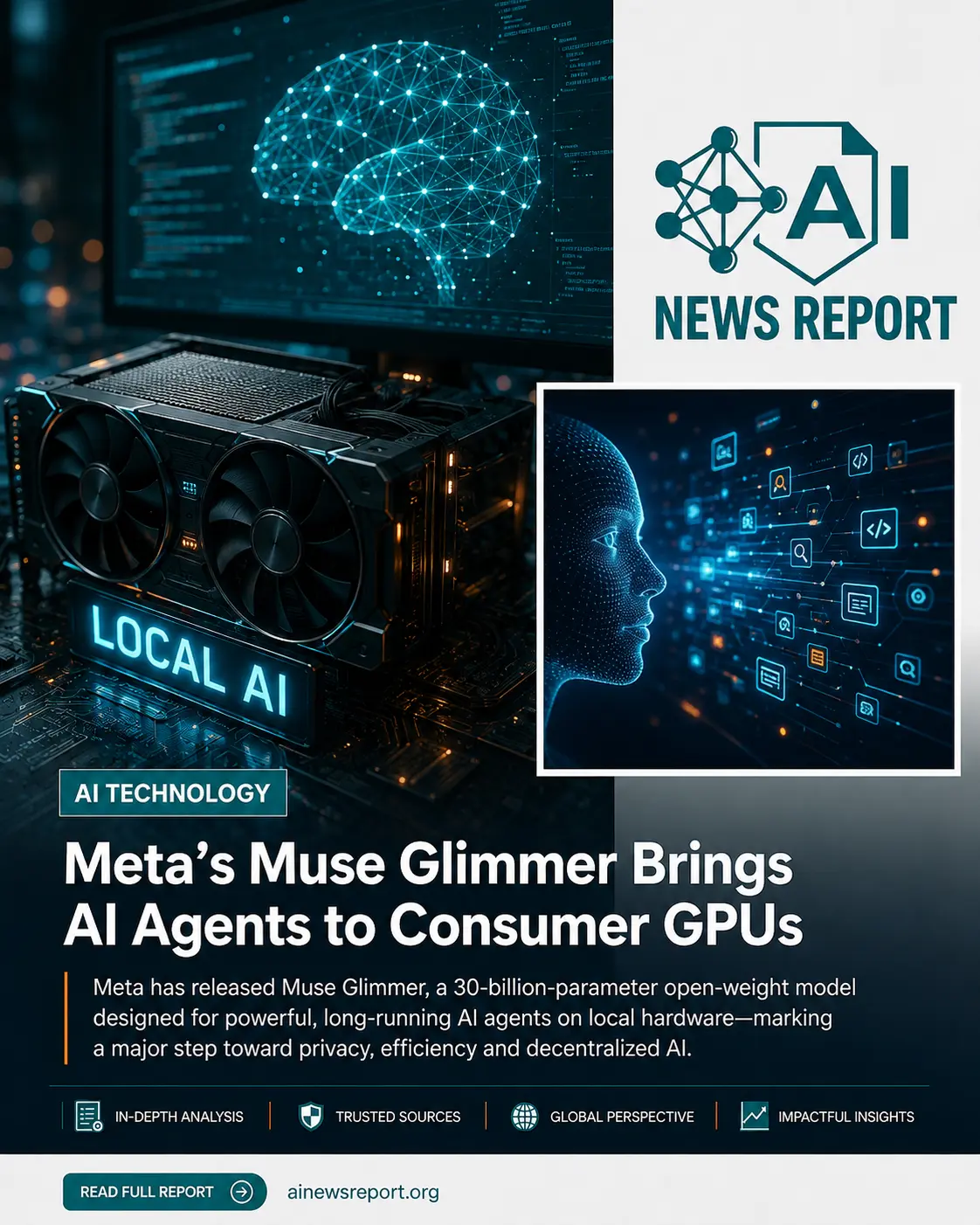
Meta has released Muse Glimmer, a 30-billion-parameter open-weight model designed for local, long-running agentic workflows. The model is built around the idea that AI should do more than respond to individual prompts. Instead, it can be used as part of systems designed to reason through tasks, interact with tools and work through multiple steps. AI News describes the release as an effort to bring local AI agents to consumer GPUs, while NVIDIA has highlighted deployment on a single GPU in supported configurations.
That makes Muse Glimmer more interesting than a routine model launch. The bigger story is the direction in which AI infrastructure is moving. As AI agents become more capable, companies are increasingly exploring ways to make them faster, cheaper and less dependent on a permanent connection to centralized cloud services.
Why Local AI Is Becoming More Important
For users, the most immediate difference between cloud AI and local AI is where computation takes place. A cloud-based AI assistant sends requests to remote infrastructure, where the model processes the information and returns a response. A local model can perform at least some of that work directly on a computer or private system, potentially reducing the amount of information that needs to leave the user's environment.
That has important implications for privacy and control. Businesses working with confidential documents, proprietary software or sensitive internal information may prefer AI systems that can operate within their own infrastructure rather than sending every request to an external provider. Local inference can also reduce dependence on network connectivity and, depending on the workload and hardware, change the economics of running AI at scale.
Performance is another factor. NVIDIA's technical coverage of Muse Glimmer highlights its design for local, long-running agentic workflows, while AMD has also published guidance for running the model on Ryzen AI Max systems and Radeon GPUs. The fact that multiple hardware vendors are already positioning the model for local deployment illustrates how quickly the ecosystem around consumer and workstation AI is developing.
Muse Glimmer Arrives as AI Moves From Chatbots to Agents
The timing of Meta's release is particularly important because the industry is shifting its attention from chatbots toward agentic AI. A conventional chatbot waits for a prompt and produces an answer. An AI agent is designed to take a goal and work through a sequence of actions, potentially using tools, retrieving information, interacting with software and adapting as it goes.
That shift changes the requirements for an AI model. An agent may need to remain active for longer periods, maintain context, interact reliably with external tools and recover when something does not go according to plan. Meta says Muse Glimmer was developed with these types of workflows in mind, rather than simply optimizing the model for short conversational exchanges. NVIDIA reports that the model has a context window exceeding 120,000 tokens and is designed for local agentic use.
The distinction matters because the usefulness of AI agents will ultimately depend less on impressive demonstrations and more on whether they can reliably perform practical work. Coding, research, document analysis, software interaction and enterprise automation are all areas where an agent that can operate locally could become valuable.
But greater autonomy also creates greater risk. An AI system that can access files, use software or execute actions has considerably more potential impact than a model that simply generates text. Local deployment therefore does not automatically make AI safer. Organizations still need access controls, monitoring, human oversight and safeguards around what an agent is allowed to do.
Local AI Could Change the Next Stage of the AI Race
The most important question surrounding Muse Glimmer is therefore not whether it is the most powerful AI model available. It is whether increasingly capable AI agents can become practical outside the largest cloud data centres.
If the answer increasingly becomes yes, the economics and structure of AI could begin to change. Personal computers, workstations, enterprise servers and edge devices could become important AI platforms alongside hyperscale data centres. Developers could choose between local and cloud inference based on the sensitivity, cost and complexity of a particular task.
That shift would also create new questions for policymakers. Open-weight AI that can be downloaded and modified is more difficult to govern through centralized controls than a service operated entirely by a single provider. As agents gain access to tools and become capable of taking actions independently, questions around accountability, safety and runtime governance will become increasingly important.
Muse Glimmer does not prove that the AI industry is leaving the cloud behind. What it does show is that the boundary between powerful AI and ordinary computing hardware is continuing to move.
The next stage of the AI race may therefore not be defined solely by who can build the biggest model. It may also be determined by who can make capable AI agents efficient enough to run locally, reliable enough to perform real work and controllable enough to be trusted.
Meta's Muse Glimmer is an important step in that direction. And if local AI continues to improve, some of the most consequential AI systems of the future may not live exclusively inside giant data centres. They may run much closer to the people using them.
References