AI Is No Longer Just a Support Technology
For years, military AI discussions often focused on using algorithms to improve existing capabilities: processing intelligence faster, identifying objects, analyzing large datasets or helping commanders make decisions. The new strategy points toward a broader role.
AI and autonomy now sit at the top level of the U.S. science and technology hierarchy, alongside the undersea and space domains. The strategy calls for a competitive advantage in AI and autonomy while seeking clear technological superiority in undersea and outer-space capabilities.
That distinction matters. It suggests Washington increasingly views autonomous systems as part of the architecture of future military power rather than simply another software tool.
The strategy's AI priorities include foundation models, planning and reasoning, perception and sensor fusion, robotics and embodied intelligence, multi-agent systems and swarm intelligence, autonomous systems, and autonomous command and control. It also explicitly includes interpretability and control, adversarial robustness and AI security.
In other words, the technology agenda is moving in two directions simultaneously: making AI more capable and making those increasingly capable systems controllable and secure.
The Rise of Multi-Agent and Autonomous Warfare
One of the most consequential elements of the strategy is its emphasis on multi-agent systems and swarm intelligence.
A single AI system can analyze information or perform a defined task. Multiple autonomous agents can potentially coordinate actions, distribute tasks and respond dynamically to changing conditions. In military environments, that could translate into networks of autonomous drones, robotic systems or software agents operating together rather than relying on one centralized system.
The strategy also identifies autonomous command and control as a critical AI capability. That raises the stakes considerably because command-and-control systems sit close to the center of military decision-making.
The technology question therefore becomes inseparable from a governance question: How much authority should an AI system have to make or execute decisions without human intervention?
The Governance Problem Is Moving From the Model to the Mission
The White House strategy's inclusion of “agent identification and authentication,” “interpretability and control,” and “adversarial robustness and AI security” is particularly revealing. These are not merely questions about whether an AI model produces accurate answers. They concern whether autonomous systems can be trusted, identified, secured and controlled when operating in potentially adversarial environments.
That distinction is increasingly important as AI systems gain access to external tools and physical systems.
An autonomous military platform may need to identify whether an instruction actually came from an authorized source. A network of AI agents may need to distinguish legitimate agents from compromised or adversarial ones. A command system may need to explain why it reached a particular recommendation. And operators may need reliable mechanisms to interrupt or override autonomous behavior. These requirements make AI governance part of military infrastructure.
Washington Is Also Trying to Change How Defense Technology Gets Built
The strategy does not only identify technologies. It also calls for faster innovation and changes to the way the government develops and acquires technology.
The document advocates reducing unnecessary administrative and regulatory barriers, strengthening public-private partnerships and accelerating the transition of federally funded research into usable capabilities. It also emphasizes protecting research and technology from foreign exploitation and strengthening resilience across critical technology supply chains.
That could accelerate the movement of AI capabilities from research laboratories into operational environments.
But faster deployment creates a corresponding challenge. If AI systems become more autonomous while procurement and deployment cycles become faster, governance mechanisms must be able to move at the same speed.
A safety review that takes years to design is unlikely to be sufficient for systems that can evolve, connect to new tools and be deployed in months.
Why This Matters Beyond the Pentagon
The strategy is formally about U.S. national security, but its implications extend into the wider AI industry.
Military demand has historically helped accelerate technologies that later spread into civilian markets. AI systems developed for intelligence analysis, robotics, cybersecurity, autonomous navigation and distributed decision-making could influence commercial AI development as well.
The strategy also makes clear that Washington sees technological competition as a national-security issue. Alongside AI, it identifies semiconductors, advanced manufacturing, communications, cybersecurity, nuclear energy, hypersonics and future computing as important enabling technologies.
This means the competition is no longer simply about who produces the most capable AI model. It is increasingly about who controls the infrastructure, chips, networks, autonomous platforms, data and security systems that allow AI to operate at scale.
The New AI Race Is About Control as Much as Capability
The most important message from the White House strategy may therefore be hidden inside its technical language.
The United States wants AI systems that can reason, coordinate, operate autonomously and work across multiple domains. At the same time, the strategy recognizes the need for interpretability, control, authentication and AI security.
That creates a fundamental tension at the heart of military AI.
The more autonomy a system receives, the more important its control architecture becomes.
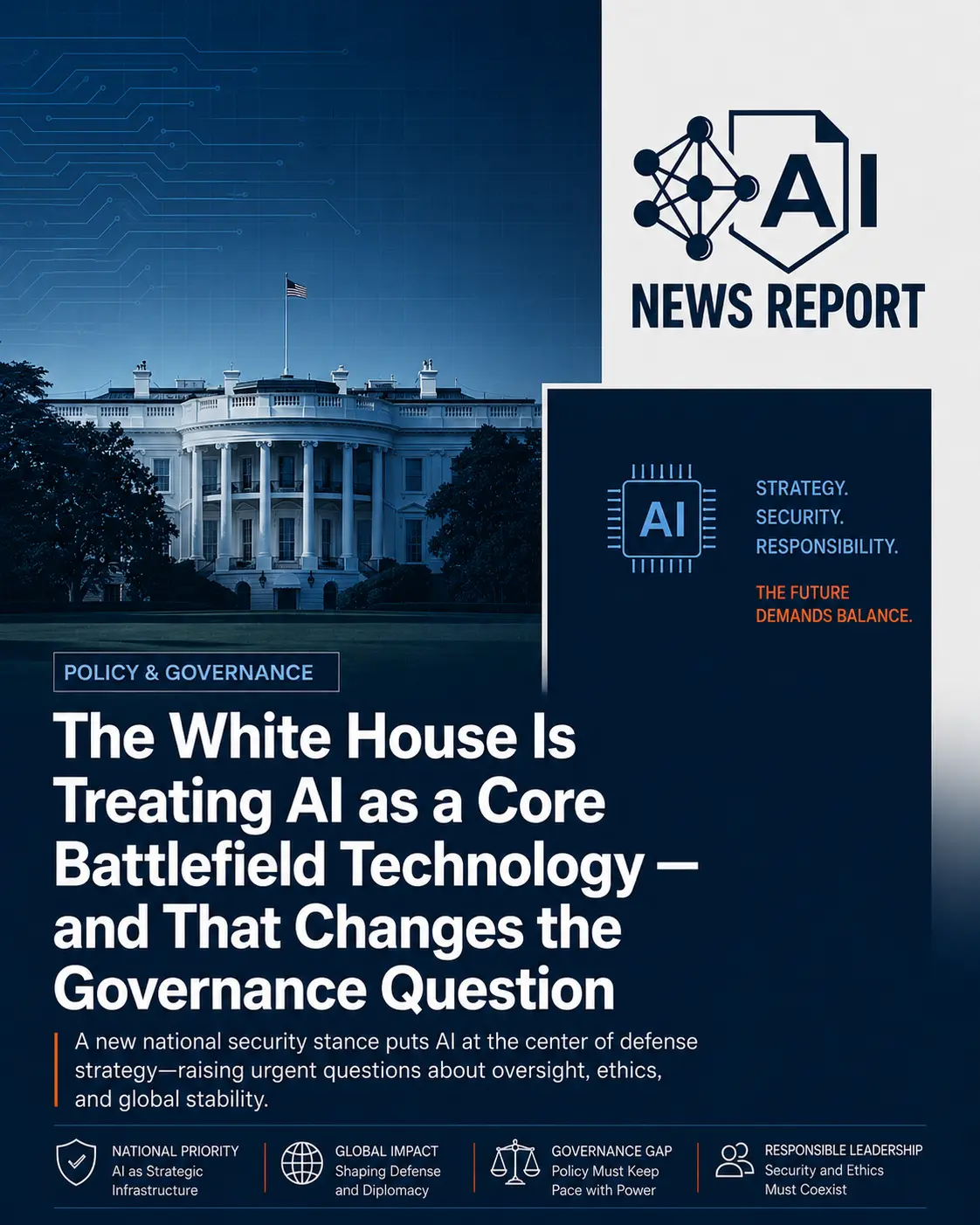
For AI News Report, that is the bigger story. The United States is not simply preparing to deploy more AI in defense. It is building a national technology strategy around increasingly autonomous systems—and acknowledging, through its own priority list, that security and control must evolve alongside capability.
The next phase of the AI race may therefore not be decided solely by which country builds the smartest model.
It may be decided by which country can build the most capable autonomous systems without losing control of them.
REFERENCES