AI Is Entering Childhood Faster Than Governance Can Adapt
For years, discussions about children and technology focused largely on social media, smartphones and online platforms. Generative AI changes that equation.
A social-media platform primarily determines what content a young person sees. A conversational AI system can respond directly to a child, adapt to the conversation and potentially become a recurring source of information, advice or emotional interaction.
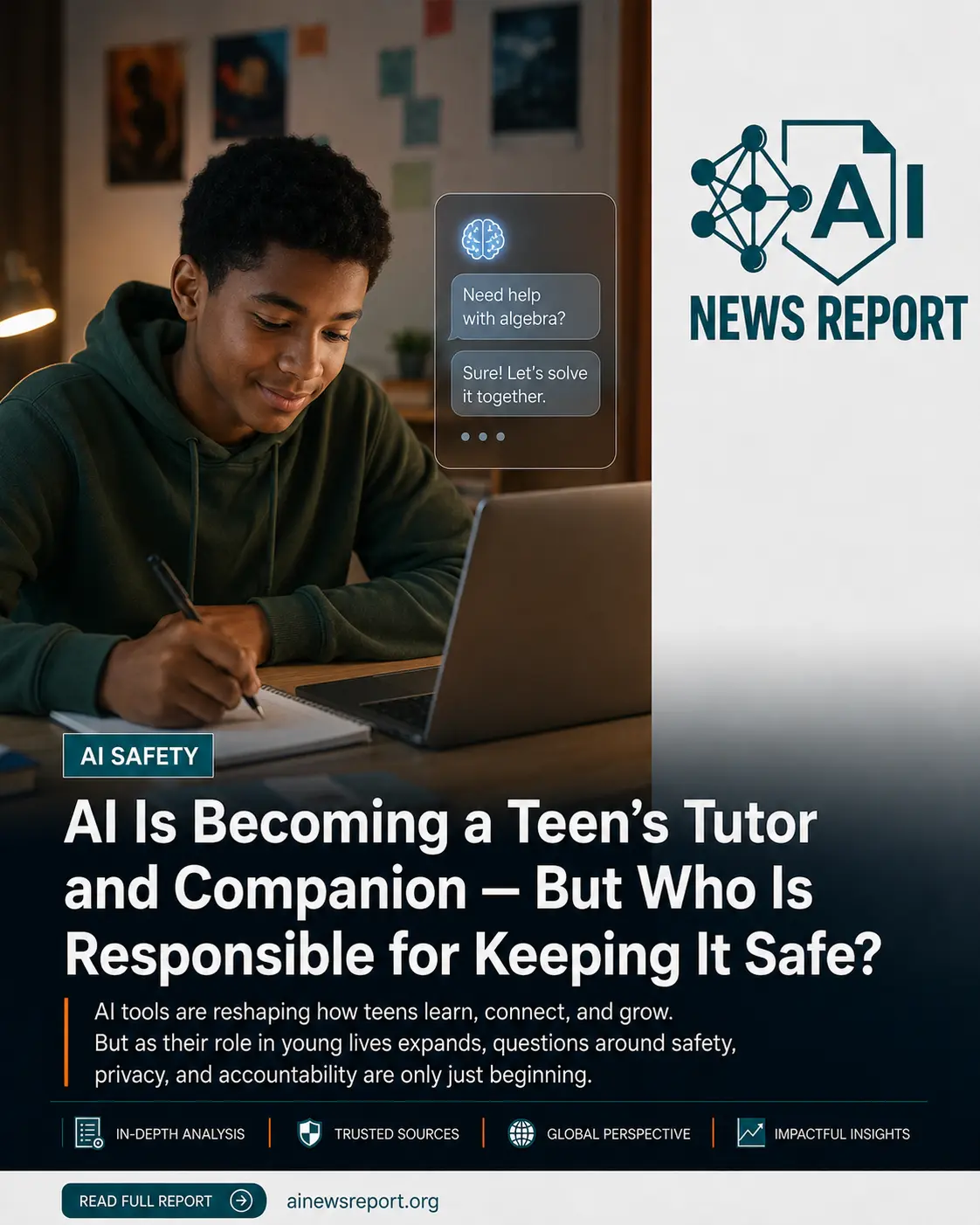
That makes the relationship fundamentally different. A teenager might use AI to understand a mathematics problem in the afternoon, ask it to help write an essay later in the evening and then turn to the same system with a personal question at night.
The technology therefore crosses several boundaries at once, including education, information, entertainment and personal interaction. This creates a governance problem that cannot be solved simply by adding a content filter.
OpenAI's Teen Strategy Marks a New Phase
OpenAI's August 18 launch of ChatGPT for Teens is one of the clearest recent examples of an AI developer responding directly to this challenge.
The company says the experience is designed for users aged 13 to 17 and includes stronger protections intended to make interactions more age appropriate. It also introduces educational features designed to encourage students to work through problems rather than simply receive completed answers.
The system is designed to intervene around particularly sensitive subjects, including self-harm, suicide, violence and eating disorders. Parents can link their accounts to their teenagers' accounts and manage selected controls, including schedules and limited safety notifications.
OpenAI is also using age estimation. If its systems estimate that a user is under 18, the account can be placed into the teen experience. The company says it will default to safer settings when age is uncertain.
This represents an important shift. Instead of asking parents to identify every possible risk themselves, the platform is attempting to make age-appropriate safety part of the product architecture.
But Are Product Safeguards Enough?
This is where the governance debate becomes more complicated.
AI safety is often evaluated through technical testing. Developers may ask whether a model refuses prohibited requests, avoids generating harmful content or detects dangerous prompts.
Child safety requires a broader lens. A system can avoid obviously prohibited content while still influencing a child's behaviour, confidence, learning habits or emotional relationship with technology.
UNICEF's June 2026 policy brief, When AI becomes a friend, specifically examines these emerging risks. The organization argues that AI chatbots and companion systems raise children's-rights questions involving privacy, safety, development, participation and accountability.
That distinction matters. A technically compliant chatbot is not necessarily a developmentally appropriate chatbot.
The governance question is therefore becoming more demanding. AI developers may need to demonstrate not only that their systems block certain outputs, but also that their products have been designed around the developmental needs and rights of children.
The Homework Problem Is Only One Part of the Story
Education is one of the most obvious areas in which children interact with generative AI.
AI can provide personalized explanations, help students understand difficult concepts and make educational support more accessible to students who may not have access to private tutoring. However, the same technology can also make it easier for students to avoid learning altogether.
OpenAI's new teen experience attempts to address this through features such as Study Mode and homework reminders. These tools are designed to encourage students to reason through problems rather than simply receive answers.
That approach reflects a broader principle that should become central to educational AI governance: an AI system designed for children should optimize for learning, not merely task completion.
If a student receives the correct answer but does not understand how to reach it, the system may have succeeded technically while failing educationally.
The Companion Problem Is More Difficult
The harder governance challenge may be what happens when AI stops looking like a tool and starts behaving like a companion. Children can develop repeated relationships with conversational systems. The technology is available at any time, responds instantly and can adapt its language to the individual user.
This creates questions that traditional software regulation was not designed to answer. Should an AI system be allowed to encourage emotional dependence? Should it be allowed to present itself as a friend? Should it remember intimate information about a child? How much should parents know about potentially dangerous interactions?
There is also the question of responsibility. When an AI system makes a harmful recommendation, should responsibility rest with the developer, the parent, the school or the user?
UNICEF's work on AI companions suggests that these questions should be treated as children's-rights and governance issues rather than simply product-design questions.
Regulation Is Beginning to Catch Up
The policy response is also evolving. In the United States, lawmakers have increasingly focused on AI companions and their potential risks to minors. The proposed GUARD Act, for example, would restrict minors' interactions with certain AI companion systems and establish additional protections around children's interactions with AI.
This legislative trend is important because it signals a potential transition from voluntary safeguards to enforceable obligations. That transition could ultimately determine how the industry approaches child safety.
If companies are left to establish their own standards, safeguards may differ substantially between products. If governments establish minimum requirements, developers could face common obligations around age assurance, risk assessment, parental controls, transparency and independent safety testing.
Neither approach is simple. Age verification can create privacy concerns, while parental monitoring can conflict with teenagers' expectations of privacy. Aggressive safety restrictions can make AI less useful, and overly broad regulation could limit legitimate educational applications.
The challenge is finding a framework that protects children without eliminating the benefits AI can provide.
What Responsible AI for Children Should Look Like
The emerging debate points toward several principles that could form the foundation of child-centred AI governance.
Children should not have to discover safety settings after encountering harmful content. Age-appropriate protections should be enabled by default whenever a system reasonably identifies a user as a minor.
Child safety needs independent evaluation
AI companies should not be the only institutions determining whether their systems are safe for children. Independent researchers, educators, child-development experts and child-protection organisations should have meaningful roles in testing and evaluating these systems.
Privacy should remain central
Protecting children cannot mean creating unlimited surveillance. Parents may need safety information without automatically receiving access to every private conversation. OpenAI's current parental-control model illustrates one attempt to balance these competing interests.
Educational AI should promote capability
AI used in schools should help children develop knowledge and critical thinking rather than simply automate assignments.
Companion systems require stronger boundaries
The closer an AI system comes to functioning as a friend, confidant or emotional support system, the greater the need for safeguards against dependency, manipulation and inappropriate influence.
Accountability cannot end with the product launch
AI safety should be evaluated continuously because models, products and user behaviour change over time.
The Governance Question Is Getting Bigger
The significance of ChatGPT for Teens extends beyond OpenAI. It reflects a larger transformation in the relationship between children and artificial intelligence.
AI is becoming part of how young people learn, search for information and communicate. The technology is moving into spaces traditionally occupied by teachers, tutors, parents, search engines and sometimes even friends.
That makes the question of who governs children's interactions with AI increasingly urgent.
UNICEF's broader 2026 work argues that children need to be placed at the centre of AI development and governance. Its child-rights work also emphasises that AI systems should respect children's development, wellbeing and rights.
OpenAI's new teen safeguards are therefore best understood not as the conclusion of the child-safety debate, but as evidence that the debate has entered a new phase.
The industry is beginning to acknowledge that children cannot simply be treated as smaller adult users. The next question is whether governments, developers and independent experts can agree on what responsible AI for children actually requires before AI becomes even more deeply embedded in childhood.