What Happened in France?
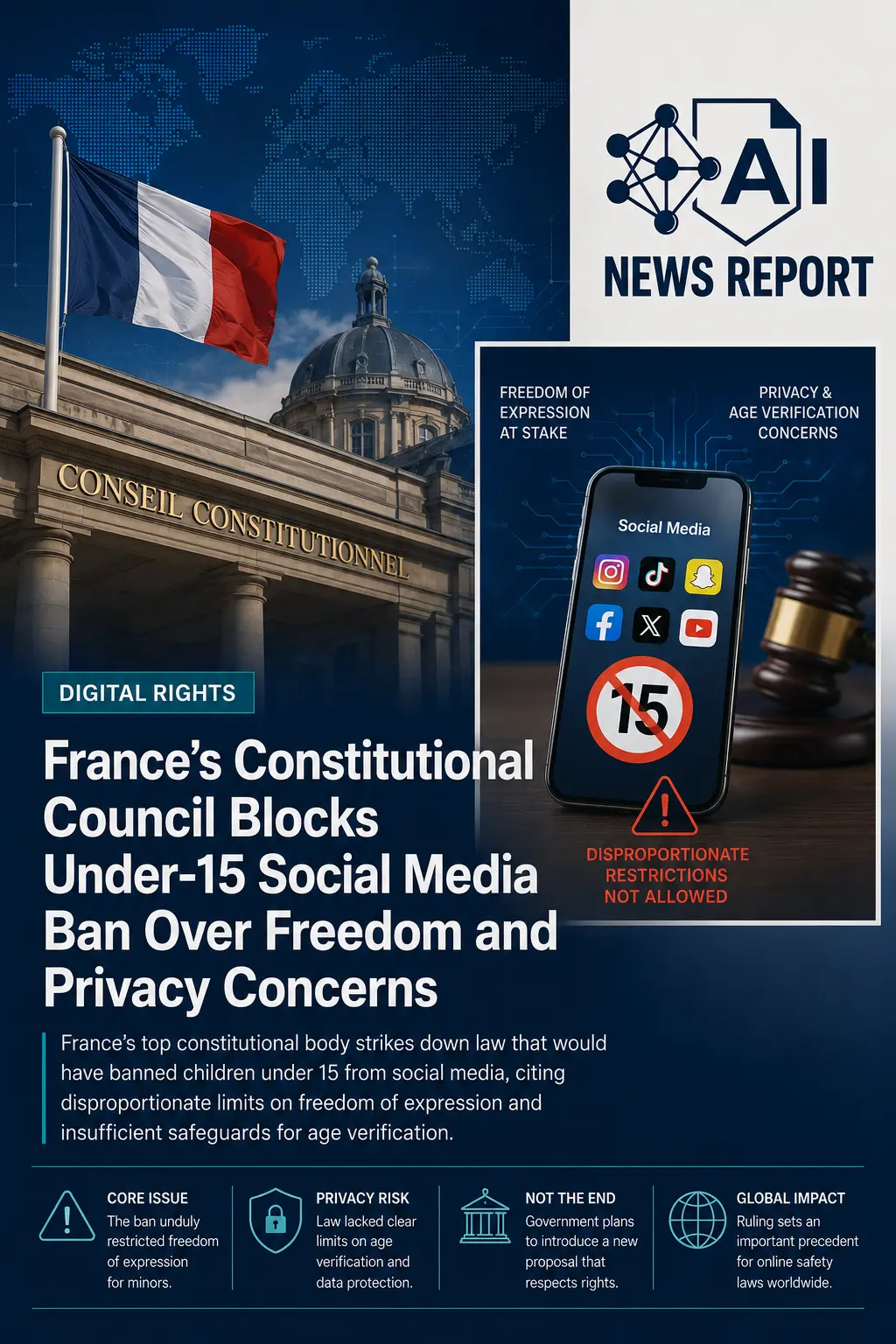
The French Parliament approved legislation in July 2026 that would have prohibited children under 15 from accessing social media services. The measure was expected to begin taking effect at the start of the September school year.
Under the proposed system, platforms would have been required to prevent under-15s from accessing covered services. Existing accounts belonging to users below the age threshold would also have been subject to closure within a set period.
The legislation was part of a wider French effort to address concerns about the effects of social media on children and teenagers. However, lawmakers challenged the legislation before the Constitutional Council. On August 14, the Council struck down the provision establishing the under-15 ban.
Why Did the Constitutional Council Reject the Ban?
One of the Council’s main concerns was freedom of expression and communication. The Council found that applying the restriction broadly to everyone under 15 was disproportionate to the objective being pursued. In other words, protecting children is a legitimate goal, but the government must make sure that the restrictions it introduces are appropriate, necessary and proportionate.
The Council also raised concerns about privacy. A system designed to stop under-15s from accessing social media would require some form of age verification. That creates a problem because users would potentially have to prove their age before accessing online services.
According to the Council, the legislation did not clearly establish the conditions and limits under which this age verification would take place. The lack of sufficient legal safeguards meant that the privacy rights of users were not adequately protected.
This makes the case particularly important. The debate is no longer simply about whether children should be protected from social media. It is also about how governments can verify age without creating unnecessary surveillance or privacy risks.
France Still Wants to Restrict Social Media Access for Children
The Constitutional Council’s decision does not mean that France has abandoned the idea of restricting children's access to social media.
President Emmanuel Macron has asked Prime Minister Sébastien Lecornu’s government to work on a revised proposal that addresses the concerns raised by the Council. The government has indicated that it still wants stronger protections for children and aims to introduce a legally sound version of the policy.
This means the French debate is likely to continue.
Instead of simply asking whether children under 15 should be allowed on social media, policymakers now have to consider what type of regulation can protect children while remaining consistent with constitutional and European legal requirements.
The Privacy Problem Behind Age Verification
Age verification is becoming one of the biggest challenges in online child-safety regulation.
If platforms must determine whether a user is under 15, they need some way to establish that person's age. Depending on the system used, this could involve identity documents, digital identity systems, biometric checks, third-party verification or other technologies.
Each approach creates different privacy and security questions.
A poorly designed system could collect more personal information than necessary or create large databases containing sensitive information about users. That is why France's decision is relevant beyond the specific social media ban.
The case highlights a wider question for digital regulation: How can governments prove that someone is old enough to access a service without forcing everyone to surrender unnecessary personal information?
Why This Matters Beyond France
France is not alone in considering stronger restrictions on children's access to social media.
Australia has already introduced a major age-based restriction, while other governments are considering similar measures. France's attempt was significant because it represented one of Europe's most ambitious efforts to introduce a legal age threshold for social media access.
The French decision could therefore influence how other countries design their own legislation.
Governments may need to be more precise about which services are covered, how age verification works, what information platforms can collect and how that information must be protected.
The Bigger Digital Governance Question
At the heart of the French case is a difficult balance.
Children need protection from online risks, including harmful content, harassment and potentially addictive platform features. At the same time, children have rights, and adults also have a right to privacy when using digital services.
A law designed to protect minors cannot simply ignore those rights.
France's Constitutional Council has therefore created an important test for future digital regulation: Can governments protect children online without creating disproportionate restrictions on freedom of expression or weakening privacy protections?
The answer could shape the next generation of online safety laws.
For technology companies, regulators and policymakers, the French case is a reminder that effective digital regulation is not only about having a strong policy objective. The mechanisms used to achieve that objective must also respect fundamental rights.
France's Constitutional Council decision shows just how complicated online child protection has become. Governments want to reduce the risks children face on social media, but they must also protect privacy, freedom of expression and other fundamental rights.
France's next attempt will therefore be closely watched. The challenge will be to design a system that protects children without requiring excessive personal data or imposing restrictions that go further than necessary.
The French debate could ultimately become a model for a much larger global discussion about the future of children's rights, privacy and social media regulation.