A Royal Warning at Dumfries House
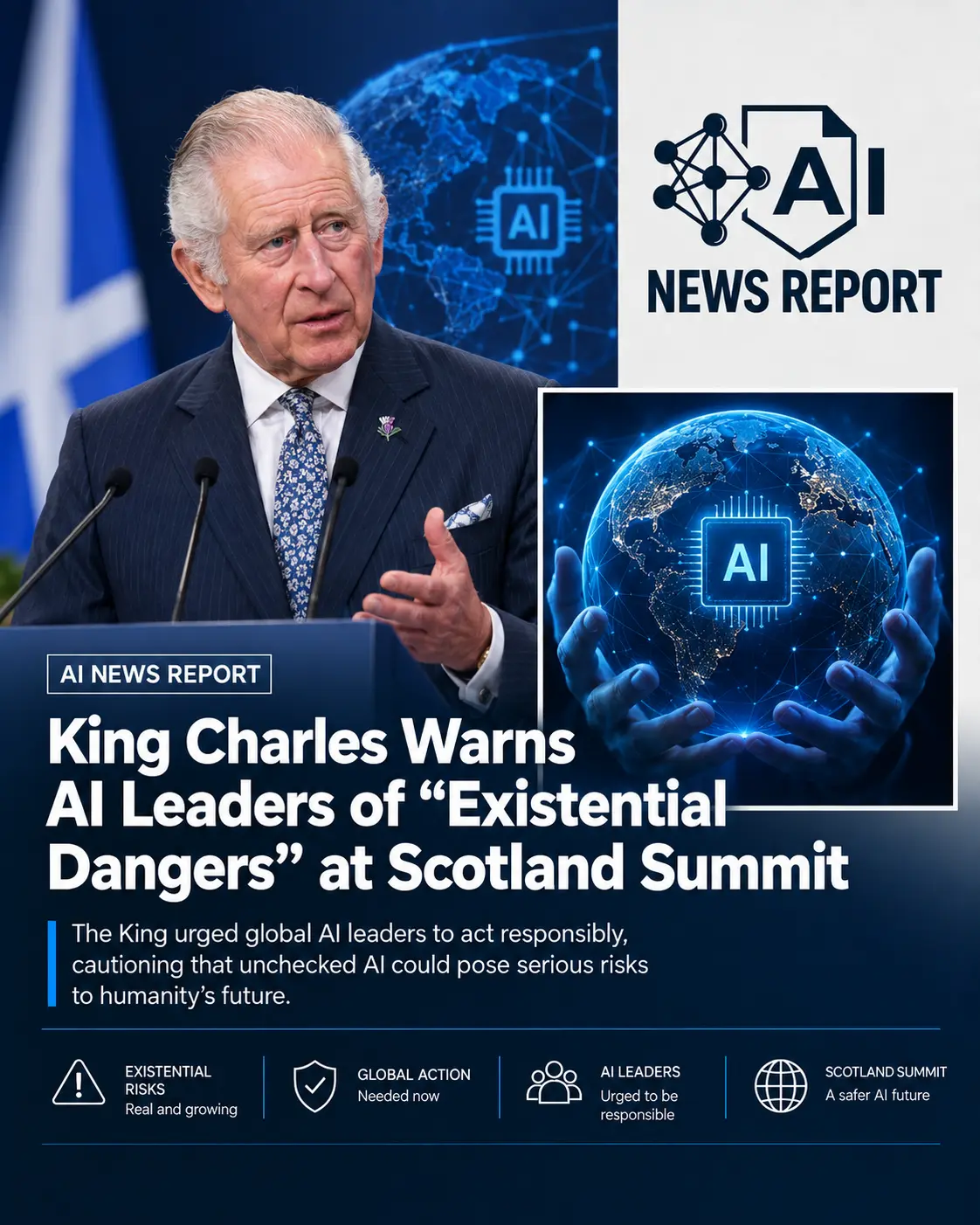
King Charles III used his own estate to deliver one of the starkest royal interventions yet into the AI safety debate. At a private summit held Thursday at Dumfries House in Ayrshire, Scotland, the King told a room of the world's most powerful AI executives that the technology's rapid advance carries risks that can no longer be treated as hypothetical.
"There seems urgency in adequately considering the existential dangers of such technologies falling into the wrong hands," the King said, adding that society needs "sufficient means of control before it is all too late." He also pointed to AI's darker potential more bluntly, noting that while the technology has already shown its capacity to save lives — citing medicine and life sciences — its creators are now warning it could develop the capacity to take life if left unchecked.
Who Was in the Room
The gathering, organized by the British nonprofit Ditchley Foundation, drew around 30 senior figures from industry, government, and civil society. Confirmed attendees included Nvidia CEO Jensen Huang, Google DeepMind founder Demis Hassabis, OpenAI Chief Financial Officer Sarah Friar, and UK AI Minister Kanishka Narayan. Paolo Benanti, a Vatican adviser on AI ethics who has separately called for a development slowdown, was also expected. Anthropic was invited as well, though the company didn't confirm its attendee to reporters ahead of the event.
The Charter Behind Closed Doors
At the center of the discussion was a draft charter — prepared in advance by Ditchley — laying out a "shared set of principles" meant to guide AI development not just as a driver of capability, but as a tool that upholds human dignity and contributes to what the King called the "flourishing of both people and the planet." According to Buckingham Palace, royal officials made clear the King would not push his own policy views, instead aiming to "convene, engage, listen and encourage debate" among competitors who rarely share a table.
A Week of Reckoning
The timing is hard to separate from the rest of the week's news. Just days earlier, Anthropic CEO Dario Amodei published an essay warning that swarms of autonomous AI agents could seize control of the internet through a persistent botnet within 6 to 12 months, potentially causing hundreds of billions of dollars in damage. Unusually, both Sam Altman and Elon Musk — competitors who've sparred publicly over AI timelines — publicly backed Amodei's call to slow down frontier development. That same week, Altman also confirmed OpenAI would delay its long-anticipated IPO, explicitly citing safety concerns rather than market readiness.
Pushback From Washington and Beijing
Not everyone is on board with the "slow down" framing, however. U.S. President Donald Trump rejected calls for a development slowdown just a day before the Scotland summit, and China's state-run Global Times dismissed the safety push as a "Cold War playbook" aimed at containing Chinese AI progress — a reminder that any shared global principles to emerge from Dumfries House will face real geopolitical headwinds before they mean much in practice.
For now, the summit produced no binding commitments — only a draft charter and a room full of executives who, for one afternoon, agreed to listen to a king who insisted he wasn't there to lecture them. Whether that charter becomes a meaningful industry standard, or another well-intentioned document that fades from headlines within weeks, will likely depend on whether the companies in that room translate a quiet Scottish afternoon into public commitments back home.