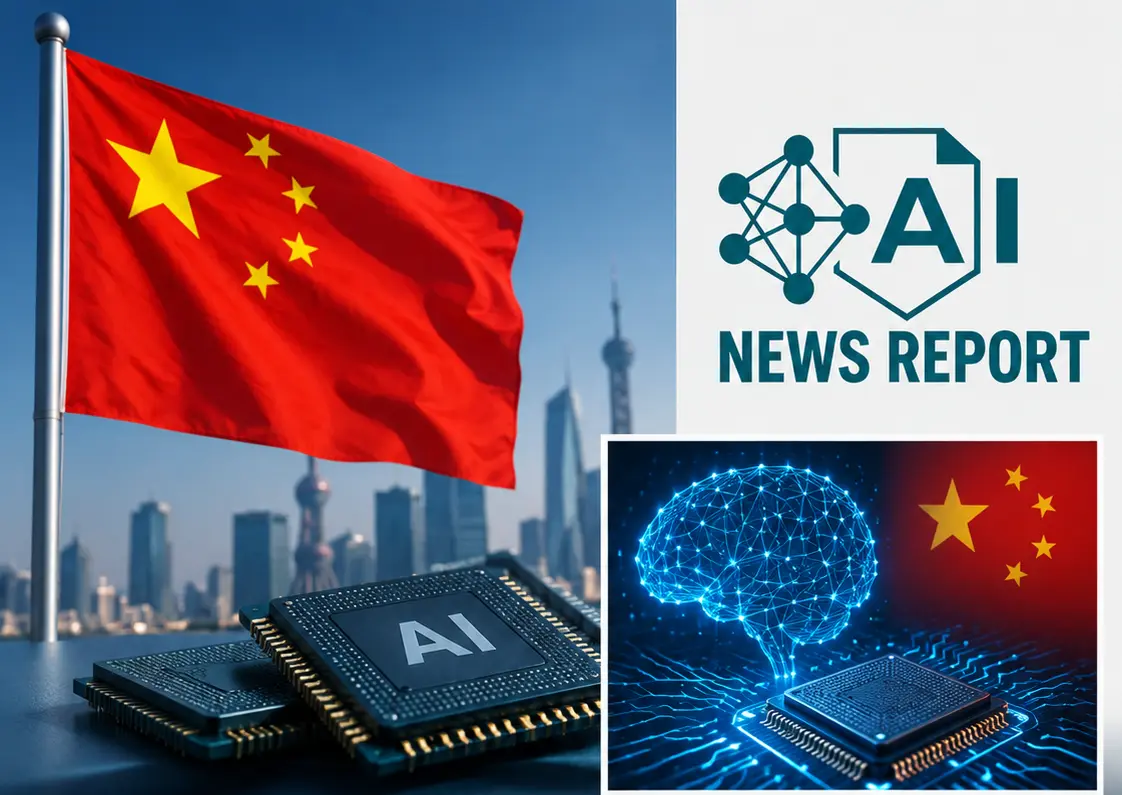
China has proposed new export controls covering 23 artificial intelligence technologies, including advanced AI models, intelligent agents and chip-design technologies, in a move that could reshape how some of its most strategically important AI capabilities are transferred overseas. The proposal was announced on October 16, 2026, by China's Ministry of Commerce and Ministry of Science and Technology. It forms part of a broader revision of the country's catalogue of technologies prohibited or restricted from export, covering 40 technologies across artificial intelligence, biomedicine and solar energy.
The announcement comes as China and the United States continue to compete over advanced AI capabilities, semiconductor technology and access to the infrastructure required to develop increasingly powerful models.
Which AI technologies could face export controls?
The draft identifies 23 AI-related technologies for inclusion in China's export-control catalogue. These include large AI models, intelligent agents, computing clusters and technologies related to information processing. Some proposed restrictions concern the transfer of core components of advanced AI models, including model weights, source code and underlying design information. The measures could also affect certain chip-design technologies and computing capabilities used to develop or operate sophisticated AI systems.
Model weights are the numerical values learned during training that help determine how an AI model behaves. Access to these weights can allow another organisation to run a model without independently reproducing its entire training process. Source code and design information can provide additional insight into how a system is built.
The draft's technical thresholds are significant because the restrictions are not necessarily intended to apply equally to every AI model. Reporting on the proposal indicates that certain exceptionally large or highly ranked models could face tighter controls on overseas transfers. The proposed catalogue does not name individual AI companies or models as blanket targets. Its implications will depend on the final technical criteria and how Chinese authorities apply them.
China says the measures are intended to address security risks
Chinese authorities have cited national security, the prevention of technological misuse and the need to maintain control over sensitive AI capabilities as reasons for the proposed measures. Advanced AI systems can have applications in scientific research, industrial automation, cybersecurity and public services. Some capabilities, however, can also be misused to identify software vulnerabilities, generate malicious code or support attacks against critical infrastructure.
The Chinese government argues that appropriate oversight can reduce the risk of sensitive technologies reaching malicious actors. The proposed controls are also presented as part of its broader approach to AI governance. The move reflects a wider international debate over whether increasingly capable AI technologies should be treated solely as commercial products or as strategic assets requiring additional oversight.
Does this mean Chinese AI tools will become unavailable overseas?
Not necessarily. The proposal distinguishes between transferring underlying technology and providing access to AI services. Chinese AI companies can continue to offer products through websites, applications and application programming interfaces, subject to applicable rules. An API allows developers to use an AI model through a software connection without necessarily obtaining its underlying model weights or source code.
This distinction matters because export controls on core technology do not automatically amount to a ban on every international use of a company's AI products. The proposed framework also provides exemptions or simplified licensing arrangements for certain open-source technologies and international research activities. Technologies already in the public domain through open-source releases or academic publications are generally excluded from the proposed controls. The precise scope of these exceptions, however, will depend on the applicable provisions and how the rules are implemented.
A wider contest over global AI leadership
China's proposal comes amid continuing restrictions on the international movement of advanced technologies, particularly semiconductor products and equipment used to develop powerful AI systems. The United States has imposed controls on certain advanced computing chips and semiconductor-manufacturing technologies destined for China. These restrictions have become an important part of the broader competition over AI infrastructure and technological capabilities.
China's proposed measures introduce another dimension to that competition: controls on the export of technology developed within China itself. If adopted, the restrictions could affect overseas partnerships, licensing arrangements, technology transfers and the international expansion of Chinese AI developers. Companies seeking to transfer covered technologies abroad may need to account for additional regulatory requirements. The proposal does not establish that all international AI collaboration will stop. Instead, it raises questions about which technologies governments consider too strategically important to transfer without oversight.
What happens next?
China is seeking public feedback on the proposed catalogue until November 15, 2026. The consultation could inform revisions before the proposed restrictions are formally adopted. In the meantime, interim registration requirements for relevant technology exports took effect on October 16. These requirements are distinct from the proposed catalogue changes themselves: the final restrictions remain subject to the consultation and subsequent implementation process.
For international AI companies, researchers and technology partners, the distinction between a draft restriction and an operative administrative requirement is important when assessing the immediate implications. The outcome could influence how Chinese AI technologies move across borders at a time when governments are increasingly examining the security implications of advanced models, computing infrastructure and semiconductor design. The central question is not whether China will stop exporting all AI technology, but how it will define the technologies that require greater control—and what those decisions will mean for international AI development.