
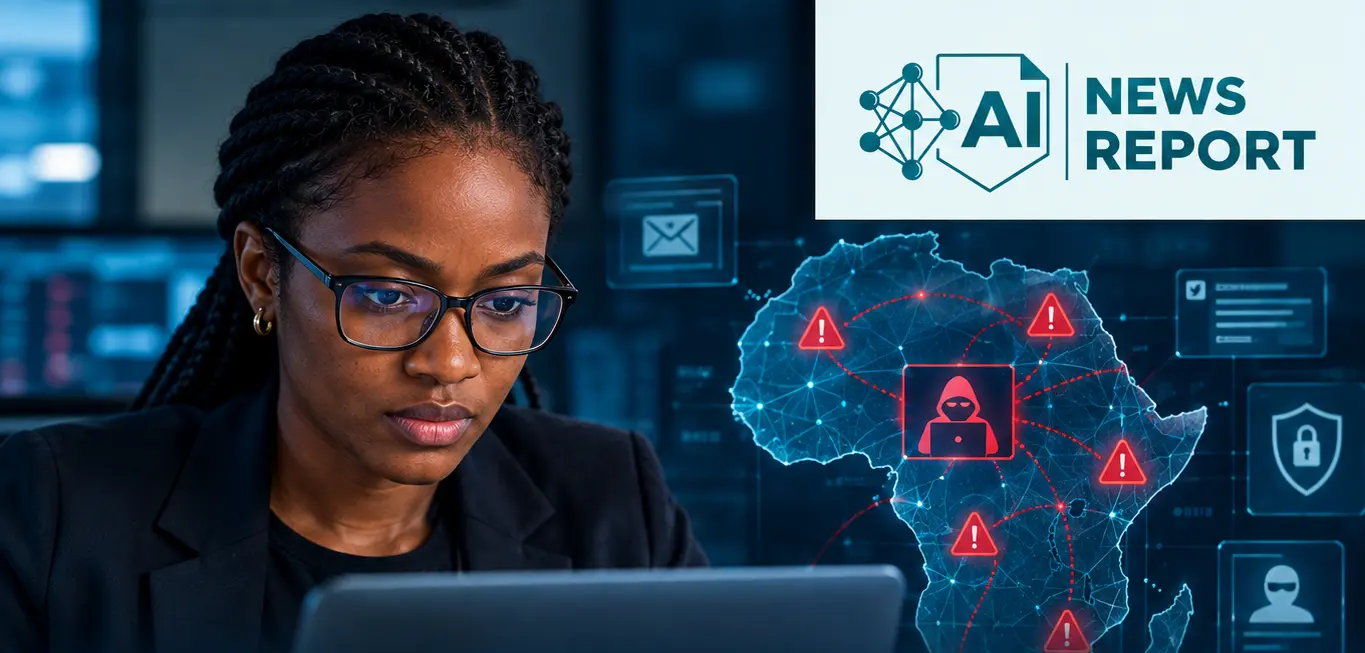
AI-Powered Cyber Threats Put Africa’s Digital Progress Under Pressure
Africa’s expanding digital economy offers opportunities for public service delivery, business growth and access to information. However, the same connectivity creates potential entry points for cybercriminals and influence operators when systems lack adequate safeguards.
In an analysis published on October 13, 2026, the Institute for Security Studies (ISS) warns that AI is enabling malicious actors to scale cyberattacks, surveillance and influence operations. The report draws on findings from Anthropic’s investigation into the misuse of its Claude AI tools, including cases involving Kenya, the Central African Republic, the Democratic Republic of the Congo, Sudan and Mali.
AI can assist with tasks such as identifying network vulnerabilities, preparing phishing material and generating large volumes of social media content. These capabilities can reduce the time and expertise required for some malicious operations, although human involvement remains important in many attacks.
Cybercrime and Disinformation Are Becoming Harder to Manage
INTERPOL’s African Cyberthreat Assessment 2026 reported that AI was linked to 55% of reported cybercrimes across Africa. The assessment, based on information from 36 African member countries, also highlighted the increasingly industrialised and cross-border nature of cybercrime. The figure should not be interpreted as meaning that AI independently carries out 55% of attacks. Rather, it reflects reported cases in which AI is linked to cybercrime activity.
Beyond financial fraud and network intrusions, AI-generated disinformation presents another challenge. Malicious operators can produce fabricated articles, imitate local voices and publish coordinated posts designed to resemble genuine public opinion.
The ISS analysis describes reported campaigns involving fabricated news in the Democratic Republic of the Congo and coordinated political messaging in Kenya ahead of its 2027 elections. Such tactics can complicate efforts to identify manipulation and protect informed public debate.
Digital Government Systems Increase the Stakes
As African governments move services online, the consequences of security failures can extend beyond individual businesses. Compromised systems may expose personal records, disrupt public services or undermine confidence in digital government. Anthropic’s threat reporting describes an investigation into AI-assisted cyber espionage in which attackers used its tools to support reconnaissance and other intrusion activities. The company says it disrupted the campaign and reported the findings to help organisations strengthen their defences.
These cases demonstrate why AI security cannot depend on technology companies alone. Public institutions, telecommunications providers, financial organisations and other businesses need coordinated ways to detect threats and respond to incidents.
What African Governments and Businesses Can Do
Preparedness starts with practical safeguards. Organisations should establish clear rules governing employee use of AI tools, restrict access to sensitive information and avoid entering confidential data into services that have not been approved for that purpose.
They should also strengthen authentication, update legacy systems, maintain tested backups and train staff to recognise phishing, impersonation and AI-generated scams. Regular security assessments can help identify vulnerabilities before attackers exploit them.
Governments can support these efforts through stronger cybersecurity strategies, appropriate regulation, incident-reporting systems and cooperation between public agencies and private-sector defenders. Media literacy and public awareness are also important in helping citizens assess suspicious messages and verify information before sharing it.
AI can strengthen threat detection and incident response as well as support attacks. The priority is to ensure that defensive capabilities, institutional coordination and accountability develop alongside adoption.
Conclusion
AI-powered cyber threats are an increasingly important challenge for Africa’s digital development. The warnings from ISS, INTERPOL and Anthropic point to the need for stronger safeguards—not a retreat from AI, but a more deliberate approach to its use.
As African countries digitise essential services and participate more deeply in the global AI economy, cybersecurity must become a core part of digital governance. The cost of delayed preparation could include financial losses, exposed personal data and declining public trust.