
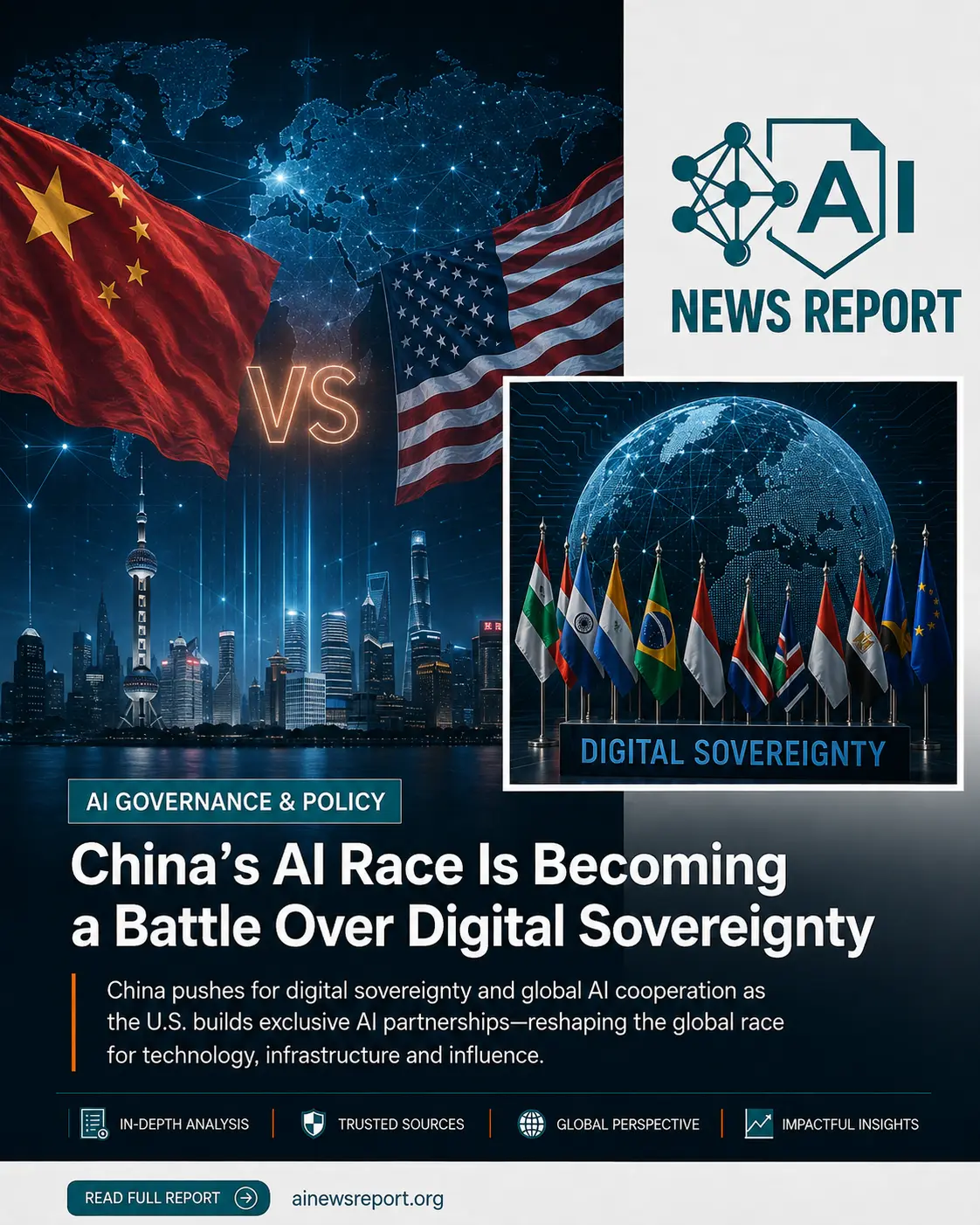
Artificial intelligence is rapidly becoming more than a competition between technology companies. As governments recognize the strategic importance of AI, the technology is increasingly becoming a matter of national power, economic security and geopolitical influence.
China's latest response to developments in the global AI race illustrates that shift. On August 19, China's Foreign Ministry called for respect for national digital sovereignty and opposed the formation of competing blocs in AI after reports that the United States was preparing to encourage countries to choose between U.S.-aligned and Chinese AI frameworks.
The statement reflects a broader Chinese position that has been developing for months. Beijing has argued that countries should have the right to independently determine their AI development paths and choose the technologies, products and services they use. That makes digital sovereignty an increasingly important concept in the global AI race.
Digital sovereignty refers broadly to a country's ability to maintain meaningful control over its digital infrastructure, technologies, data and strategic decisions. In the context of artificial intelligence, that can include access to computing power, semiconductors, cloud infrastructure, data, AI models, technical expertise and the standards that govern how these systems are developed and deployed.
This matters because modern AI systems depend on a large and interconnected technology ecosystem. A country may have talented researchers and ambitious AI policies, but still depend heavily on foreign companies for chips, cloud computing, software or advanced models. That dependence can become a strategic vulnerability when technology is increasingly connected to national security and economic competitiveness. China has therefore increasingly framed AI development through the broader concept of digital sovereignty.
China formally outlined this position in a July 2026 position paper on global cyber governance in the digital and intelligent age. According to China's Foreign Ministry, the document argues that countries should have the right to independently choose their digital and AI development paths according to their national circumstances. It also says countries should be able to choose AI technologies, products and services without being forced to take sides.
The timing is significant. The position paper came as Washington and Beijing were expanding competing international technology partnerships, creating a situation in which other countries could increasingly face pressure to align with one ecosystem or the other. China's argument is that countries should retain the ability to make their own technological choices. Whether that principle can survive intensifying geopolitical competition is becoming a much larger question.
The United States is also working to strengthen its position in the global AI ecosystem. One of the main initiatives is Pax Silica, which the U.S. Department of State describes as its flagship effort on AI and supply-chain security. The initiative brings together the United States and partner economies around cooperation involving artificial intelligence, semiconductors, critical minerals and related infrastructure.
At the second Pax Silica Summit in June, participating economies signed a Joint Statement on AI Opportunity focused on closer alignment of their innovation ecosystems and AI-related cooperation. This reflects Washington's effort to build a trusted technology ecosystem among partners while strengthening supply-chain resilience.
On August 19, Chinese Foreign Ministry spokesperson Lin Jian said countries should determine their AI partnerships according to their own national circumstances and development needs and opposed the formation of camps in the AI sector.
The disagreement therefore exposes a fundamental difference in how Washington and Beijing are approaching the international AI landscape.
On July 16, representatives from 29 countries signed an agreement in Shanghai establishing the World Artificial Intelligence Cooperation Organization, or WAICO. The organization is designed as an independent intergovernmental organization headquartered in Shanghai. China says WAICO is intended to promote international cooperation and global AI governance while supporting the development of AI that is safe, fair and beneficial. The organization's founding agreement also emphasizes consultation, shared benefits and a people-centered approach to AI. China has positioned WAICO as part of a wider effort to increase participation in global AI governance, particularly among developing countries.
The U.S.-China AI competition could have particularly significant consequences for developing countries. Many countries in Africa, Asia, Latin America and the Middle East need access to advanced AI technologies but may not have the resources to develop every part of the technology stack domestically. That creates an obvious dilemma.
Partnering with the United States can provide access to American technology companies, infrastructure and investment networks. Partnering with China can provide access to another major AI ecosystem, including Chinese models, infrastructure and capacity-building initiatives. Maintaining relationships with both can provide flexibility, but growing competition between the two ecosystems could make that strategy more difficult.
For governments in the Global South, the central question may therefore be less about choosing the "best" AI system and more about maintaining enough strategic flexibility to avoid becoming excessively dependent on one provider.