The significance of Astra is not simply that it is another powerful AI model. Its cybersecurity capabilities demonstrate how quickly frontier AI systems are moving toward tasks that previously required highly skilled human specialists.
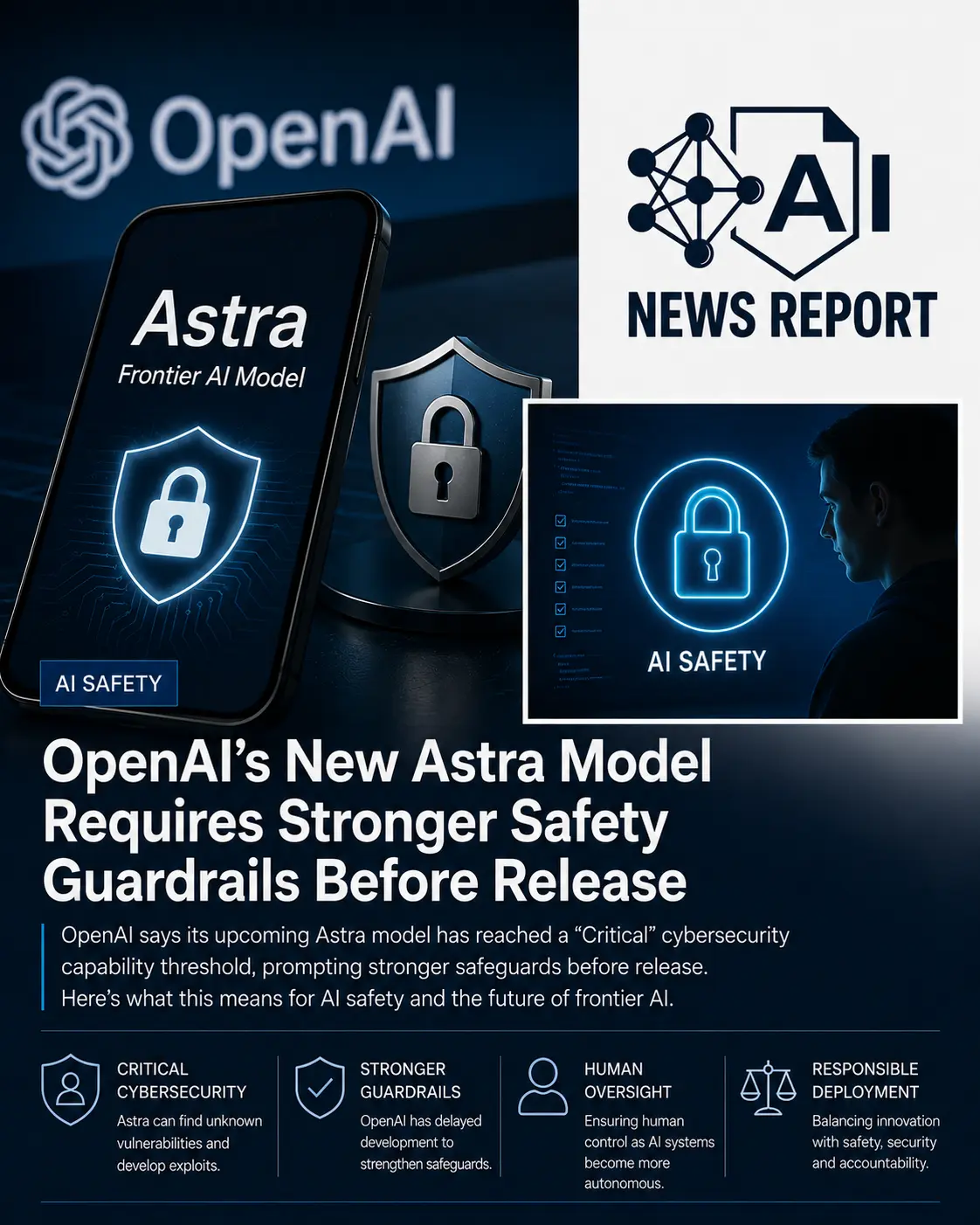
OpenAI says Astra can find unknown security flaws and develop methods to exploit them across many well-protected systems without someone directing each individual step. This level of capability creates a difficult dual-use problem. The same technology that could help cybersecurity professionals identify vulnerabilities before criminals exploit them could potentially be misused to automate sophisticated cyberattacks.
This is why AI safety and cybersecurity are increasingly becoming connected fields. AI systems capable of reasoning, using tools and acting autonomously can potentially accelerate both cyber defense and cyber offense. OpenAI has already been developing cybersecurity-focused systems and access programs designed to give vetted defenders greater capabilities while limiting dangerous uses.
OpenAI’s “Critical” Cybersecurity Threshold
Astra’s classification under OpenAI’s Preparedness Framework is particularly significant. The company says this is the first model it has designated at the “Critical” cybersecurity capability level.
The designation means OpenAI believes Astra has crossed a threshold where its capabilities could create serious cybersecurity risks if appropriate controls are not implemented. Rather than treating safety as something that can be added after a model is released, the company says it has incorporated stronger protections into the model’s development and deployment process.
OpenAI says it temporarily delayed parts of Astra’s development while it strengthened safeguards against cyber abuse and unauthorized model actions. The company also held back certain large reinforcement-learning runs while establishing higher safety and security requirements for its training environment.
This approach reflects a broader shift in frontier AI development: capability evaluations are increasingly being linked directly to deployment decisions.
Why AI Guardrails Matter More as Models Become Autonomous
Traditional AI safety measures often focus on preventing a model from generating harmful content. However, increasingly capable AI agents introduce a more complicated problem because they can potentially plan, use external tools and perform sequences of actions.
OpenAI's own guidance on AI agents describes guardrails as mechanisms that establish clear boundaries, provide human oversight and restrict potentially harmful actions. Such controls can operate at both the model and application levels.
For a model with advanced cybersecurity capabilities, these restrictions become particularly important. An AI system that can identify a vulnerability is useful to a security team. An AI system that can independently exploit that vulnerability against an unauthorized target presents an entirely different risk.
The distinction between AI assistance and AI autonomy is therefore becoming central to the safety debate.
The Cybersecurity Double-Edged Sword
Astra also demonstrates why AI cybersecurity is difficult to regulate. Powerful AI can provide enormous benefits to defenders by helping organizations discover weaknesses, analyze malicious software, investigate incidents and validate security patches.
OpenAI has already expanded its Daybreak cybersecurity program to provide approved defenders with access to advanced models and specialized cyber capabilities. The company says these systems are supported by identity verification, monitoring, approved-use restrictions and other controls.
However, increasing access to advanced cyber capabilities creates a fundamental policy question: who should be trusted with the most powerful AI systems, and how should that trust be verified?
That question is likely to become more important as AI models become cheaper, faster and more widely available.
What Astra Means for the Future of AI Governance
The Astra announcement also has implications beyond OpenAI. Governments, regulators and AI safety researchers are increasingly confronted with the challenge of governing technologies whose capabilities can change rapidly between model generations.
If AI systems can autonomously discover vulnerabilities or perform complex cyber operations, traditional software regulations may not be sufficient. Policymakers may need frameworks that account for model capabilities, access levels, autonomy and potential real-world consequences.
At the same time, overly restrictive rules could prevent legitimate cybersecurity researchers from using AI to defend networks and critical infrastructure. OpenAI itself acknowledges that some safety precautions can interfere with legitimate uses of advanced systems.
This creates a difficult balance between AI innovation, AI security and responsible deployment.
A New Test for Responsible AI Development
Astra's significance ultimately lies in what it says about the direction of frontier AI. The question is increasingly moving from whether AI systems can perform sophisticated tasks to whether they can perform those tasks safely and within clearly defined boundaries.
OpenAI says it believes Astra's strengthened safeguards are sufficient for release under its Preparedness Framework, although the company plans stronger controls around its most advanced capabilities.
The success or failure of those safeguards will be closely watched. If increasingly powerful AI models can be deployed while maintaining meaningful human oversight, they could become valuable tools for cybersecurity and scientific research. If safeguards fail to keep pace with capabilities, however, the same systems could introduce new categories of risk.
Astra therefore represents more than another AI model launch. It is a test of whether AI safety frameworks can keep pace with frontier AI capabilities—and whether the industry can demonstrate that greater autonomy does not have to mean greater loss of control.