
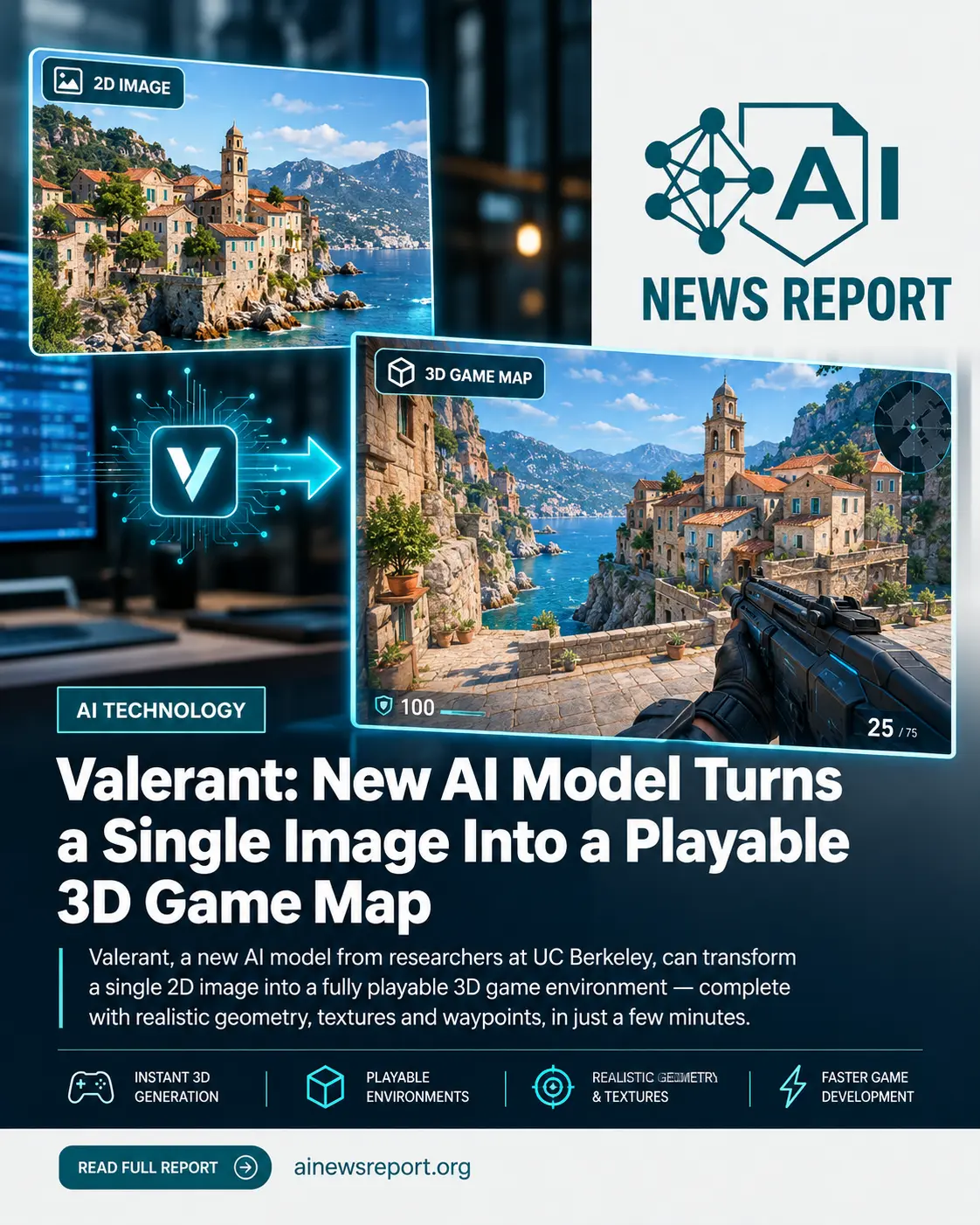
A new AI research paper is proposing a way to sidestep one of game development's most time-consuming tasks: building explorable 3D maps by hand. The framework, called Valerant, takes a single image as its only input and generates a fully navigable 3D environment around it, using a technique its authors describe as action-conditioned world model exploration.
The Problem Valerant Is Trying to Solve
World Action Models, or WAMs, are AI systems that combine two capabilities: predicting what the world will look like next, and generating actions based on that prediction. This class of model has advanced quickly in embodied AI fields like robotics and autonomous driving, where the physical world already exists independently of the model — a robot's arm or a self-driving car operates in a real, persistent 3D space, so the model's job is mainly to predict and act within it.
Games are a different story. Most existing AI-driven approaches to game world generation combine action-conditioned world models with external policies and reward systems, but they typically stay confined to 2D visual observation space. In other words, they can generate plausible-looking video of what a player might see next, but there is no actual 3D geometry underneath those frames — no persistent map that a game engine could use to resolve collisions, camera movement, or object interactions consistently over time. For most 3D games, particularly first-person titles, that persistent, coherent 3D space is a hard requirement, and existing world models simply were not built to produce it.
How Valerant Works
Valerant addresses this gap by converting a pretrained, frozen action-conditioned world model into a functioning World Action Model without any further training. Starting from a single input image, a virtual agent repeatedly queries the world model, asking it to generate multiple candidate video rollouts corresponding to different possible actions or movements. Rather than following a fixed path, the system evaluates these rollouts and commits to the one that scores highest for exploration — meaning it reveals the most new, previously unseen area.
Each committed rollout is then fed into a SLAM-based reconstruction pipeline. SLAM, short for Simultaneous Localization and Mapping, is a well-established technique from robotics used to build a coherent map of an environment while simultaneously tracking a device's position within it. By applying SLAM to the world model's predicted rollouts, Valerant assembles a persistent 3D point-cloud map piece by piece, effectively translating imagined video frames into explorable geometry.
The authors describe this as a "counterfactual exploration procedure," since the system is constantly generating and evaluating alternative predicted futures before selecting which one to commit to the growing 3D map. Over repeated cycles, a single starting image can expand into a much larger, coherent explorable space.
Why This Matters for Game Development
The paper's authors frame Valerant as a new direction for what they call game-map authoring: the idea that a single visual concept — a piece of concept art, a mood-board image, or an early environment sketch — could be expanded automatically into a playable 3D space. If it works reliably at scale, this could meaningfully reduce developers' reliance on manual, labor-intensive map construction, one of the more time-consuming aspects of building game environments.
It's worth noting this is early-stage academic research, not a shipped product. The paper, published to arXiv on September 8, 2026, sits within a broader wave of 2026 research on World Action Models, alongside related work on robotic manipulation, autonomous driving simulation, and general-purpose video world models. Whether techniques like Valerant make their way into actual game engines and production pipelines will depend on further validation of map quality, consistency, and how well the generated geometry holds up under real gameplay conditions like collision detection and multiplayer synchronization.
Still, the direction is a notable signal: as generative video and world models mature, researchers are increasingly trying to push them beyond passive content generation and into tools that can produce usable, structured assets — in this case, the literal ground game developers build on.