What the AHM Statement Actually Says
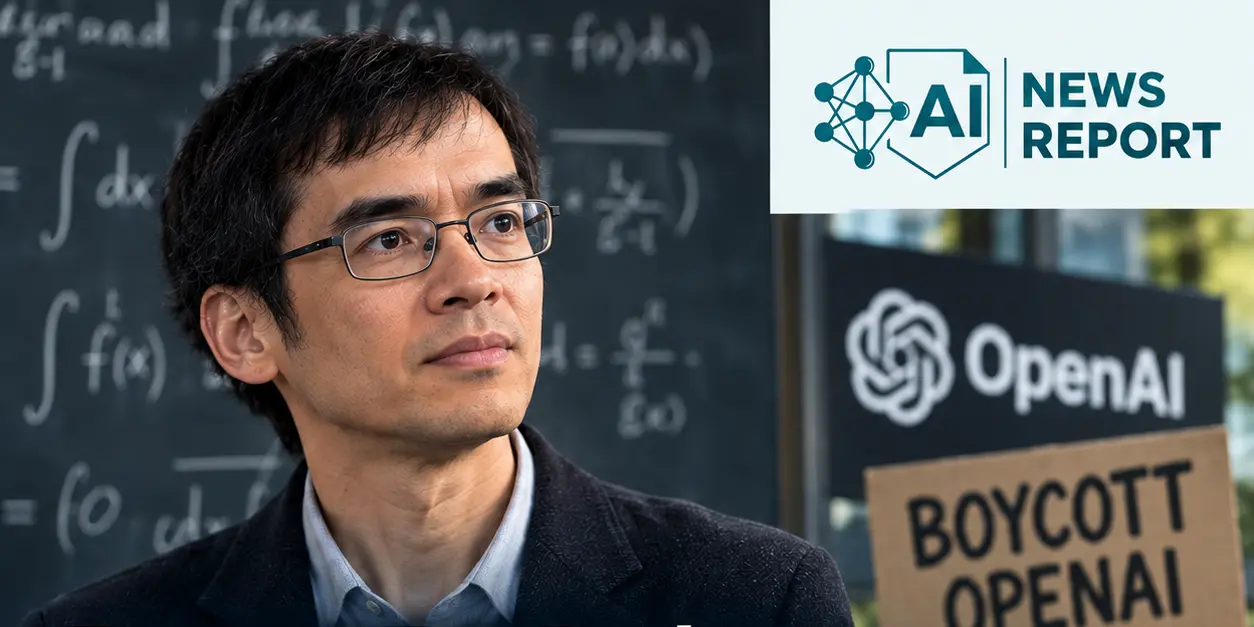
The statement’s central argument isn’t really about accuracy, it’s about scale and intent. “Releasing over 700 files at once is not a demonstration of scholarship, but a demonstration of power,” the AHM Communications Working Group wrote. “We urge mathematicians to discontinue their work with OpenAI and to return to a vision of science that centers human understanding.” The statement also pushes back on OpenAI’s own framing of the release, stating plainly that mathematicians “did not ask for this work to be done,” and criticizing the company for proceeding despite what the statement describes as advice against testing advanced problems on internal models in this manner.
It’s worth noting precisely how this circulated: Tao hosted the statement as a guest post rather than authoring it himself, and reporting from Kingy.ai specifically points out that Tao does not appear on AHM’s published membership list, a distinction that matters given how widely the story has been framed as “Tao’s boycott” rather than an outside group’s statement that Tao chose to amplify.
Why the Timing and Scale Struck a Nerve
OpenAI’s release itself is substantial by any measure, 722 manuscripts across 372 distinct result families, covering number theory, geometry, algebra and theoretical computer science, generated by a model that hasn’t been publicly released. The company has acknowledged that unverified proofs in the batch may contain errors, and the early track record bears that out: three manuscripts have already been withdrawn and fourteen revised following initial scrutiny from the mathematics community.
That combination, enormous volume released all at once, against a backdrop of acknowledged unverified content, is precisely what critics argue overwhelms the field’s normal capacity for peer review and verification. Tao’s own framing, reported separately, warns that AI is “reaping” open problems at a pace that leaves entire subfields “less fertile,” his concern being less about any single wrong proof and more about what happens to a research area once its open problems have been rapidly harvested by a system that, as he’s noted elsewhere, often can’t engage with follow-up questions, give talks, or explain its own reasoning the way a human collaborator could.
Tao’s Consistent, More Complicated Position
What makes Tao’s involvement notable is that it doesn’t fit neatly into a simple “anti-AI” narrative. He has consistently advocated for integrating AI tools into mathematical work, and has previously participated in OpenAI-adjacent events, including a fireside conversation with OpenAI’s Mark Chen at a UCLA-hosted, OpenAI-co-organized convening on AI and mathematics earlier this year. His objection, based on his own writing, isn’t to AI assisting mathematicians, it’s to turning fundamental research into what he’s characterized as a corporate benchmarking exercise, where speed and volume of “solved” problems become the metric that matters, rather than explanation, community engagement, and the opening up of genuinely new research directions.
This is a continuation of a position Tao has held for some time, not a sudden reversal. In September, he joined 24 other Fields Medalists in signing a separate statement warning of a “severe misalignment” between what the AI industry is optimizing for and what mathematics as a discipline actually needs to thrive.
A Divided Response From the Field
Comments on Tao’s blog post, which had drawn 88 responses at the time of this reporting, show real disagreement within the mathematics community about whether a boycott is the right response, or even a coherent one. Some commenters back the call directly and extend it further, proposing that researchers stop using OpenAI’s products entirely and pushing for stronger protections on preprint servers like arXiv against being mined for AI training data without consent.
Others push back on the AHM statement’s own logic. Kingy.ai’s analysis specifically singles out the statement’s claim that mathematicians “did not ask for this work to be done” as its weakest point, arguing that research has never historically required an invitation from an established community before someone else attempts it, a norm the critique suggests AHM’s statement runs against. There’s also pushback circulating, noted directly in the comments on Tao’s own blog, against what some describe as a broader false narrative that mathematicians as a field are uniformly anti-AI, when the reality within the community is considerably more divided.