YouTube Music Introduces Labels for AI-Generated Tracks
YouTube Music is taking a new step toward identifying AI-generated music, introducing labels designed to help listeners understand when generative AI has played a significant role in creating a song. The announcement, published on October 14, 2026, responds to growing interest in transparency as generative AI tools become increasingly capable of producing musical compositions, vocals and other creative elements.
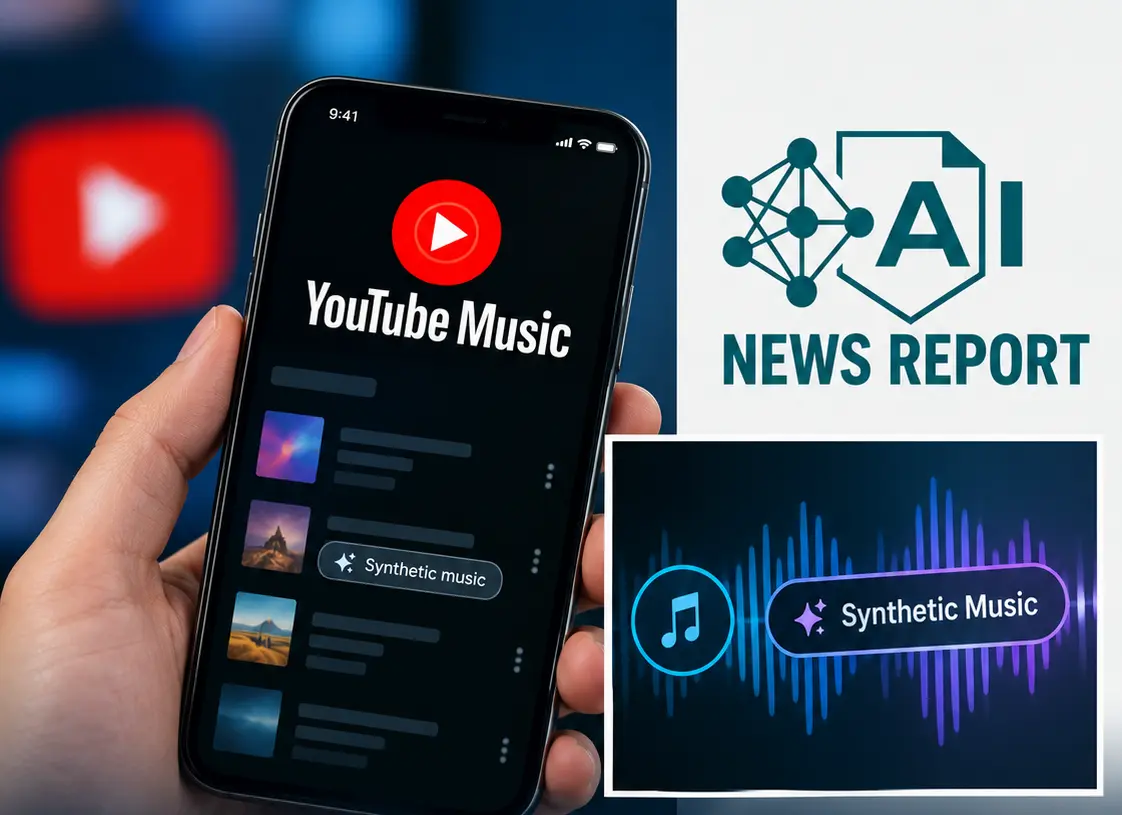
According to YouTube, the new labels will appear directly on the player page when a track has been created primarily using generative AI. One example provided by the company involves a generative model producing both a song’s composition and vocals. Listeners will be able to select the label to access additional information about the role AI played in producing the track. The feature is intended to make that information easier to find while people listen, rather than requiring them to investigate a song’s production history separately. YouTube has also indicated that the labels will expand beyond YouTube Music to the main YouTube app.
How YouTube Plans to Identify AI-Generated Music
Identifying AI-generated music can be difficult, particularly when human musicians and AI tools contribute to the same production. To address this challenge, YouTube says it will work with its music partners and use internal detection tools to identify tracks that should receive AI labels. Music partners can disclose generative AI involvement through metadata submitted with their content. YouTube's guidance provides three classifications: “Fully Gen AI,” “Partly Gen AI” and “No Gen AI.”
These categories distinguish between content created entirely with generative AI, content involving some generative AI, and content that does not involve generative AI. The company may also use additional signals when partner disclosures are unavailable. This means that a missing declaration does not necessarily prevent a track from being identified as AI-generated.
However, the system's effectiveness will depend partly on the quality of partner disclosures and the reliability of YouTube's detection methods. The company has not publicly detailed every signal its systems use to determine whether a track qualifies for a label. The announcement also does not establish that every song containing any AI-assisted element will receive the same visible label. YouTube's stated focus is on music created primarily through generative AI.
Why AI Music Labelling Matters
Generative AI has lowered some of the technical barriers to music production. People can use AI tools to generate melodies, vocals and complete compositions, creating new opportunities for experimentation and distribution. At the same time, the growing availability of AI-generated music has intensified debates about creative ownership, transparency, compensation and the place of human musicians in the industry.
For listeners, labels could provide useful context when deciding what to listen to and how to interpret an artist's work. For musicians, producers and record labels, clearer disclosure could help distinguish different production methods in an increasingly crowded digital music market. The initiative also raises questions about how platforms should define AI-generated music. A track created entirely by an AI system differs from one in which a musician uses AI to develop a single instrumental element before recording vocals and performing the rest of the music.
Clear classifications may help address these differences, but labelling alone does not resolve broader disputes over copyright, ownership, royalties or the use of artists' voices and musical styles in AI training. YouTube's announcement does not specify whether the new labels will change how tracks are recommended, monetised or compensated. Their immediate stated purpose is to improve transparency for listeners.
YouTube Joins a Wider Industry Shift
YouTube Music's announcement comes as other streaming services develop their own approaches to identifying AI-generated content. Spotify has introduced AI disclosures in music credits, while Deezer has developed technology to detect and label fully AI-generated music. Apple Music has also communicated plans for AI transparency labels.
These approaches differ in their implementation and scope. Some rely heavily on disclosures from artists, labels or distributors, while others combine those disclosures with technical detection systems. The growing attention to AI labelling reflects a wider challenge for digital platforms: how to support new creative technologies while giving audiences meaningful information about the content they consume.
For YouTube, the rollout provides a way to make AI involvement more visible within its music experience. Whether the labels will substantially change listener behavior or industry practices remains to be seen. As AI-generated music continues to develop, the effectiveness of these measures will depend on consistent disclosures, accurate identification and how transparently platforms explain the technology behind the music.
What Comes Next?
YouTube says its new AI music labels will extend to the main YouTube app, although the company has not provided a detailed timetable for that expansion. Further questions concern how the system will handle music that combines human performances with AI-generated elements, how often detection errors may occur, and whether additional information about AI involvement will become available to listeners.
For now, the rollout marks a significant development in how one of the world's major music platforms communicates the role of generative AI in music creation. The labels will not settle every debate about AI and the creative industries, but they introduce another layer of disclosure as platforms, musicians and audiences adapt to a changing music landscape.